


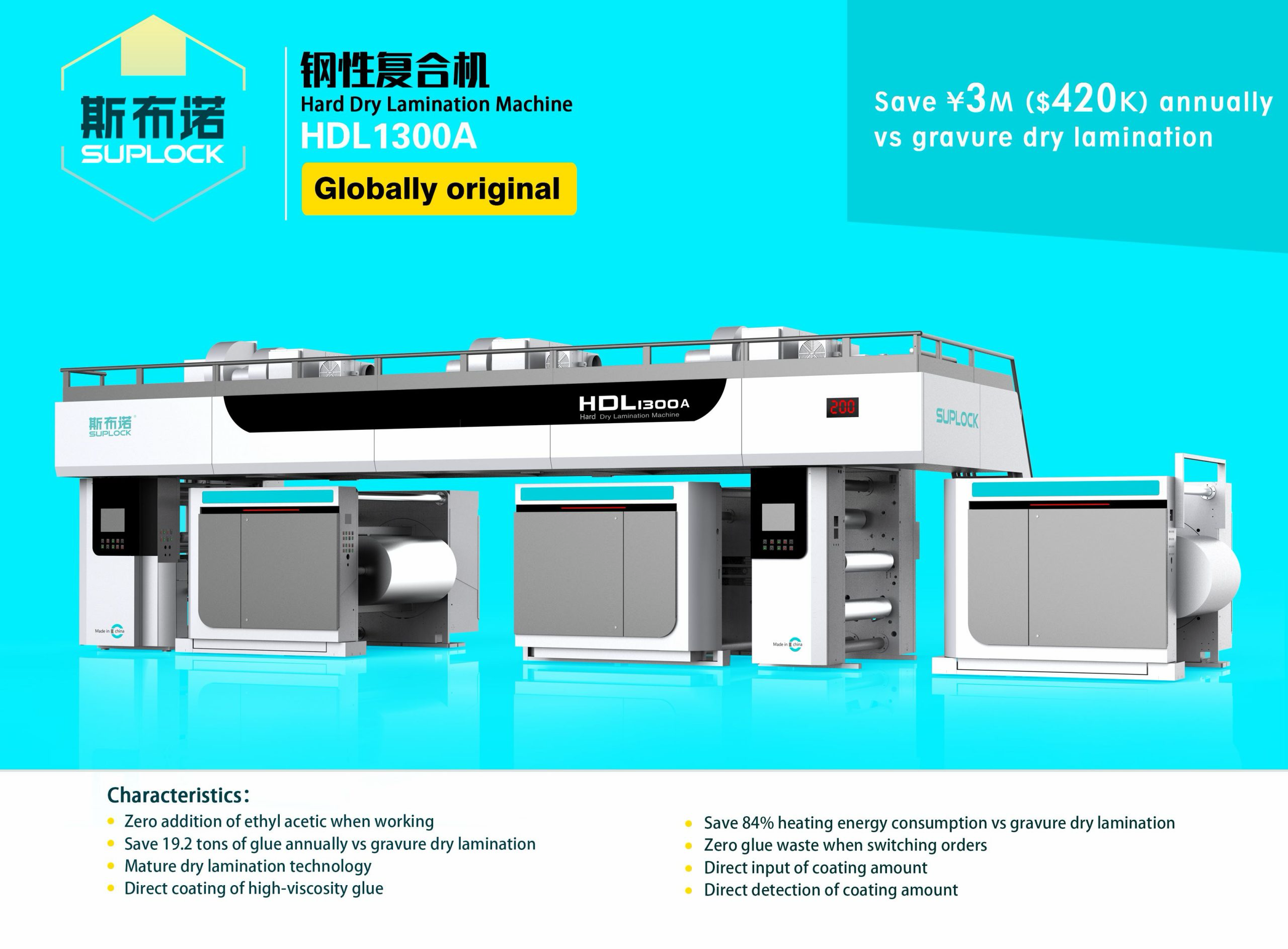
A solventless laminating machine supplier with after-sales support China is judged on two things: the machine that lands and the people who answer after it lands. XIAOPAI supplies the HDL1300A hard-dry laminator as SINSTAR's authorized global distributor, and the service scope sits in the order rather than in a call centre script.
The HDL1300A is a solvent-free machine built for board and thick film. It runs at up to 350 m/min on a 1,350 mm web, takes 800 mm rolls at both ends, and lays 1.5 to 4.5 gsm of adhesive. The rest of this page is what those numbers mean, what arrives with the machine, and what support covers.
THE MACHINE IN FOUR NUMBERS
Speed is a ceiling, not a promise. 350 m/min is the top of the range, and the rate a converter holds depends on the adhesive, the coating weight and how fast the bond sets on the heated rollers. A trial at the intended recipe settles more than a catalogue comparison.
Width and roll size decide how the machine fits a plant. A 1,350 mm web covers full board widths, and 800 mm on both the unwind and the rewind sets how long a run goes before a doff. Shaftless loading at the unwind matters at this width, because a full roll on a shaft needs a crane and two people on every change.
| Item | HDL1300A |
|---|---|
| Maximum laminating speed | 350 m/min |
| Maximum laminating width | 1,350 mm |
| Unwind and rewind diameter | 800 mm each |
| Coating weight | 1.5 to 4.5 gsm |
| Loading | Shaftless at the unwind |
The HDL1300A hard-dry laminator is not the right machine for every job, and the page that follows says where the line sits.
WHAT HARD DRY MEANS FOR THE BUYER
Hard dry describes how the bond sets, not what the adhesive is made of. A high-solid adhesive at 75 % solids goes onto the web as it arrives, heated rollers bring it to working temperature, and the bond is set before the laminate reaches the rewind. There is no drying tunnel because there is no solvent to remove.
| Route | How the bond sets | What it means on the floor |
|---|---|---|
| Solvent-based dry | Solvent driven off in a tunnel | Solvent handling, extraction, residue |
| Ordinary solventless | Two-component cure at room temperature | Hours before the bond is fully set |
| Hard dry | Cured on heated rollers | Handled at the rewind, no solvent |
The heat has to be even across the web, not just high at the centre. Electrically heated rollers are used for that reason, and the adhesive only performs if the roller surface is uniform from edge to edge.
WHAT ARRIVES WITH THE MACHINE
Handover is a list, not a handshake. The order should name the drawing set, the adhesive data for the recipe being run, the spare-parts list, and the commissioning report that records the settings the machine actually ran at.
Commissioning is where the buyer learns the machine. The people who attend should be the ones who can set the nip, read a tension curve and explain why a bond failed. XIAOPAI holds the contract as authorized distributor and coordinates that visit with SINSTAR, who build the machine in Chongqing.
Training belongs in the same week. An operator who knows how to enter a coating weight, how to check it on the web and how to change a roll without a crane will keep the machine inside its envelope. A second shift needs the same hour of training, not the notes from the first.
WHAT AFTER-SALES COVERS
The support route follows the supply route. XIAOPAI holds the contract as authorized distributor, and the technical answers come from SINSTAR, who build the machine in Chongqing. Support on a laminator is mostly about the coating head and the rollers. Wear parts are few, but they are the parts that decide whether the coating weight stays where it was set. Ask for the wear list in writing, with the lead time for each item, before the machine is ordered.
Adhesive questions belong in the same channel. A new film or a new board usually means a new recipe, and the supplier who sold the machine is the one who knows what the heating rollers can hold across a shift.
Coating faults are easier to prevent than to cure. Even coverage across the width is a separate problem from the average figure on the panel, and cross-web uniformity of hot melt adhesive coating is where most of them begin. A roller that carries dried adhesive leaves value on its surface instead of on the web, and roller surface condition belongs on the daily check.
The maker states that switching orders wastes no adhesive and that the machine uses about 0.3 g/m² less than a gravure dry laminator. Those are the maker's figures, and the service visit is where they get checked against the buyer's own stock.
WHAT AFTER-SALES DOES NOT COVER
A supplier cannot fix a substrate that refuses the adhesive. Bond strength starts on the surface rather than at the nip, and surface energy of the substrate decides whether the adhesive wets the board evenly. Roller pressure cannot rescue a surface that will not accept it.
Three more limits are worth naming. Adhesive choice stays with the buyer, room temperature and dust stay with the plant, and an operator who changes a recipe without recording it creates a fault no service visit can trace. Paper-based work adds its own rules, because waterborne barrier coatings for paper-based packaging behave differently from film laminates in the same press.
FOUR QUESTIONS BEFORE THE ORDER
The first is who attends commissioning, by name and by employer. The second is how far the nearest engineer sits from the plant. The third is which spares are held in stock rather than built to order. The fourth is who trains the second shift.
A supplier who answers all four in writing is telling you something about the next five years. A supplier who answers only the first is telling you something else.
WHO BUILDS IT, WHO HOLDS THE CONTRACT
SINSTAR builds the HDL1300A in Chongqing. XIAOPAI supplies it worldwide as authorized global distributor, and the figures in this article are the maker's published values for this model. Configuration, spares and service scope are confirmed per project.
WHERE THE MACHINE FITS
The substrates are board and thick film: cardboard, art paper, white card, grey board and labels that must laminate without warping, plus PET, PC, PVC, BOPP, optical film and protective film. The output is luxury packaging, gift boxes and premium print, along with food, pharmaceutical and personal care laminates where ethyl acetate is not allowed.
Two jobs belong elsewhere. A converter running thin flexible structures needs the i9 solventless laminator or the S1 digital solventless laminator. A converter working in sheets needs the sheet-fed hot knife laminator. Buying the HDL1300A for either job is how a good machine ends up on the wrong floor.
A solventless laminating machine supplier with after-sales support China is worth the name when the machine, the handover and the wear list arrive together. One without the others is a delivery, not a supply.


