


A power transmission and distribution equipment supplier with CE certification China is not a supplier that owns a certificate. It is a supplier whose design can be tested against the claims in that certificate, model by model, for the ratings in the order. The difference shows up when a 35 kV cast-resin transformer is opened for a factory test.
The SC(B)9 range covers 30 to 2,500 kVA at 35 or 38.5 kV, with low voltage from 0.4 kV to 15 kV and vector groups Dyn11, Yyn0, Yd11 and YNd11. Five design decisions decide whether the CE file describes this range or something else.
The electrical choices come first. A Dyn11 unit with a 0.4 kV secondary feeds a building distribution board, while a 10.5 kV or 15 kV secondary couples the transformer to a plant network. The tap range of ±5 % or ±2 × 2.5 % keeps the secondary inside its window when the incoming voltage sits high or low. The tap position belongs on the test sheet as much as on the nameplate.
EVIDENCE ONE: PARTIAL DISCHARGE STARTS IN THE CAST
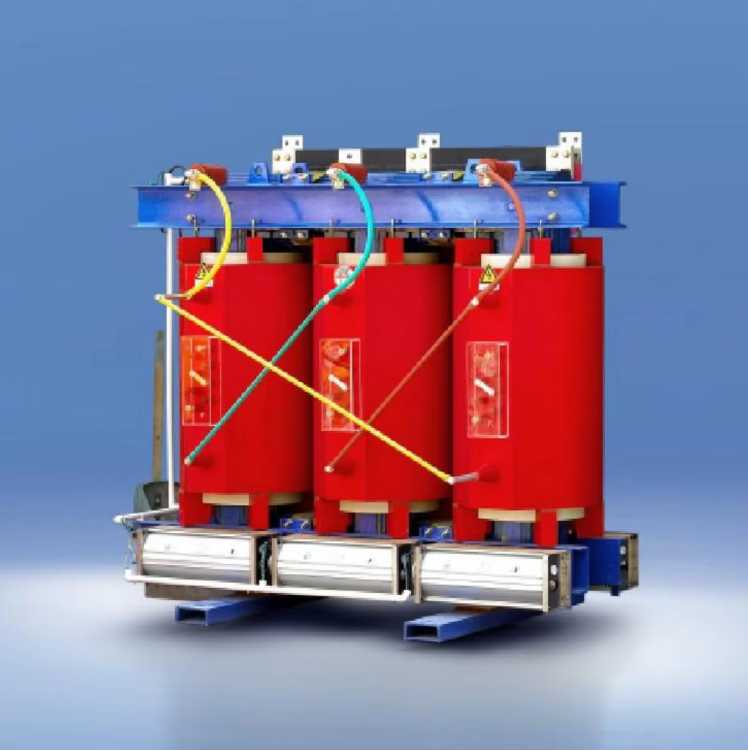
The high-voltage winding is vacuum cast in epoxy, with a glass-fibre grid on the inside and the outside of the coil. The grid carries mechanical load and limits the movement that a short circuit would otherwise impose on the winding. The vacuum cast is what keeps voids out of the insulation.
Partial discharge is the test that finds those voids. A porous casting produces a discharge figure that no declaration can explain away, and a clean casting produces a figure that can be printed in a report. This is why the casting process sits in the CE file rather than in the brochure.
EVIDENCE TWO: TEMPERATURE RISE AND THE 140 % CLAIM
The low-voltage winding is foil rather than wire, wound with axial cooling ducts and DMD resin pre-preg between layers. Foil keeps the ampere-turns even across the width, and the ducts give heat a path out of the coil. Larger ratings add ventilation ducts inside the winding.
Cooling is handled by cross-flow top-blow fans, and the temperature is watched by a controller with fault alarm, over-temperature alarm and over-temperature trip. The controller keeps a black box record and connects over RS485 for central monitoring. The maker states that the unit can run at 140 % of rated load in air cooling for an extended period.
Temperature rise is the evidence behind that statement. Load loss is quoted at 120 °C for this range, which is the reference temperature the test report has to use. A buyer comparing two quotations should check that both loss figures sit on the same reference before comparing them.
EVIDENCE THREE: LOSSES AND NOISE COME FROM THE CORE
The core is built from imported cold-rolled silicon steel with a mitred joint, bound with F-class tape and coated in epoxy. The coating reduces no-load current and core noise, and the mitred joint keeps the flux path tight at the corners.
Across the range, no-load loss runs from 0.35 kW at 30 kVA to 5.00 kW at 2,500 kVA. On-load loss at 120 °C runs from 0.85 kW to 21.5 kW over the same span, and no-load current falls from 2.8 % to 1.4 %. Short-circuit impedance is 6.0 % across the range, which keeps the fault level predictable for the switchgear upstream.
That 6.0 % is a design decision rather than a catalogue accident. A lower figure would shrink the transformer and raise the fault current that the vacuum circuit breaker has to interrupt, and a higher figure would raise the voltage drop at full load. Six percent is the point where a 35 kV distribution transformer stays inside both limits for this range.
EVIDENCE FOUR: THE ENCLOSURE AND ITS IP RATING
The enclosure is an option rather than an afterthought. Protection is offered at IP20 or IP23, in cold-rolled steel or stainless steel, with side or top cable entry and a standard outgoing busbar. A special entry pattern can be built to the project drawing.
The IP rating belongs in the CE file because it defines where the unit may be installed. A dry-type transformer has no oil to burn, which is why it is chosen for indoor rooms and for buildings where a fire barrier around an oil-filled unit would cost more than the transformer. Fire barriers around electrical infrastructure are still required in many rooms, and the dry-type unit reduces the fire load that the barrier has to contain.
THE RANGE IN ONE TABLE
Six ratings show the shape of the range. For a power transmission and distribution equipment supplier with CE certification China, this table is the part of the file a buyer can check arithmetically. Every loss figure has a rating and a reference temperature beside it. The full table runs from 30 to 2,500 kVA in nineteen steps.
| Rating (kVA) | No-load loss (kW) | On-load loss at 120 °C (kW) | No-load current (%) | Body weight (kg) | Weight with enclosure (kg) |
|---|---|---|---|---|---|
| 30 | 0.35 | 0.85 | 2.8 | 680 | 730 |
| 100 | 0.65 | 2.30 | 2.4 | 890 | 960 |
| 315 | 1.32 | 4.20 | 2.0 | 1,730 | 1,790 |
| 630 | 2.09 | 7.73 | 1.8 | 2,630 | 2,700 |
| 1,250 | 3.18 | 12.8 | 1.6 | 4,470 | 4,540 |
| 2,500 | 5.00 | 21.5 | 1.4 | 6,930 | 7,030 |
Two ratios matter for a room design. Body weight grows about ten times across the range while the enclosure adds 50 to 70 kg, so the floor loading is driven by the transformer rather than by the sheet steel around it. No-load current falls by half, which matters on a long feeder where the transformer is the only load left overnight.
WHAT THE FACTORY TEST HAS TO SHOW
A factory test on this unit covers the routine items and the evidence behind the declared values. Insulation resistance, winding resistance, ratio and vector group confirm that the build matches the drawing. A partial discharge measurement confirms the casting, and a temperature-rise record confirms the cooling design.
The nameplate is the last check. Its rating, vector group, impedance and tap range have to match the declaration and the order, because a unit that passes every test but carries the wrong nameplate becomes a documentation problem at commissioning.
The measurement chain matters as much as the test. Data-driven reliability work starts with records that can be compared across units, which is why the test report should carry the reference temperature and the test date rather than a summary figure.
The monitoring option extends the same idea into service. A controller with RS485 can feed a building system, and remote monitoring turns a walk-round into a trend line. Digital integrated units go further, and the question of whether to specify a digital transformer is really a question about who reads the data.
WHERE THE CERTIFICATE STOPS
CE documentation describes the model that was tested and the standards it was tested against. It does not prove that the losses hold on a site running at 60 % load, and it does not cover installation, cable termination or the room the unit sits in.
It also does not replace the service conditions. The range is built for indoor use at altitudes up to 1,000 m. The air limits are +40 °C maximum, +30 °C daily mean, +20 °C annual mean and −30 °C minimum. A site outside that envelope needs a different design, not a different certificate.
Efficiency rules keep moving, and a buyer who plans a fleet should read the loss column against the market rather than against the certificate alone. Efficiency standards are a live argument in several markets, and the direction has been towards lower losses rather than higher ones.
WHAT THE SUPPLIER HAS TO PROVIDE
Wenzhou Xiaopai Electric Power Technology Co., Ltd. manufactures the SC(B)9 35 kV cast-resin range in Wenzhou, Zhejiang, and supplies it against the project specification. The CE declaration is issued against the model list in the order, together with the routine test report for each unit and the type-test evidence behind the declared losses and temperatures.
For a project that also needs the upstream equipment, the same range includes the 35 kV oil-immersed transformer for outdoor positions and the switchgear assembly that distributes the load. The vacuum circuit breaker sits between them and is set against the transformer's rated current. The dry-type range page carries the full model list.
A certificate is a claim about a design. The test report is the evidence that the design was built on the day, and the two have to name the same rating before either one means anything.


