


FIVE STAGES DO NOT MAKE A LINE
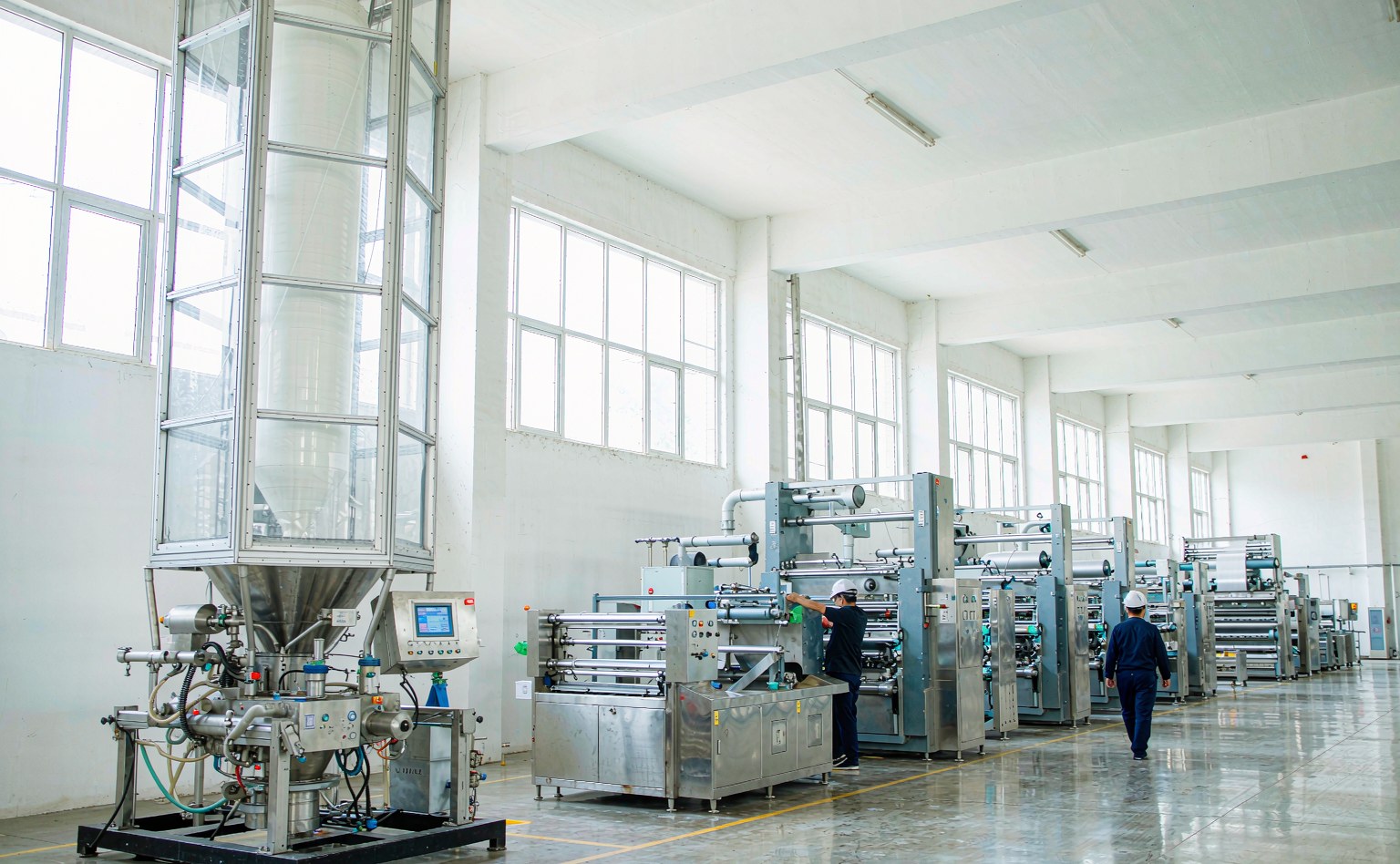
Every stage publishes its own rate, and the rates are never identical: blowing runs between 100 and 120 m/min and delivers 200 to 300 kg/h of film, lamination at 450 m/min, printing to 150 m/min, slitting at 400 m/min. Even if they matched, the stages would still drift apart, because each one stops for its own reasons - a roll change here, a job change there, a blade change somewhere else. Without a buffer, every stop travels. Printing stops and the laminator starves within minutes; the laminator stops and the slitter has nothing to run; the slitter stops and the cores pile up. With a buffer, a stop becomes local again. That is the whole function: not to store material, but to stop one stage's bad hour from becoming the line's bad day.THE FOUR BUFFERS
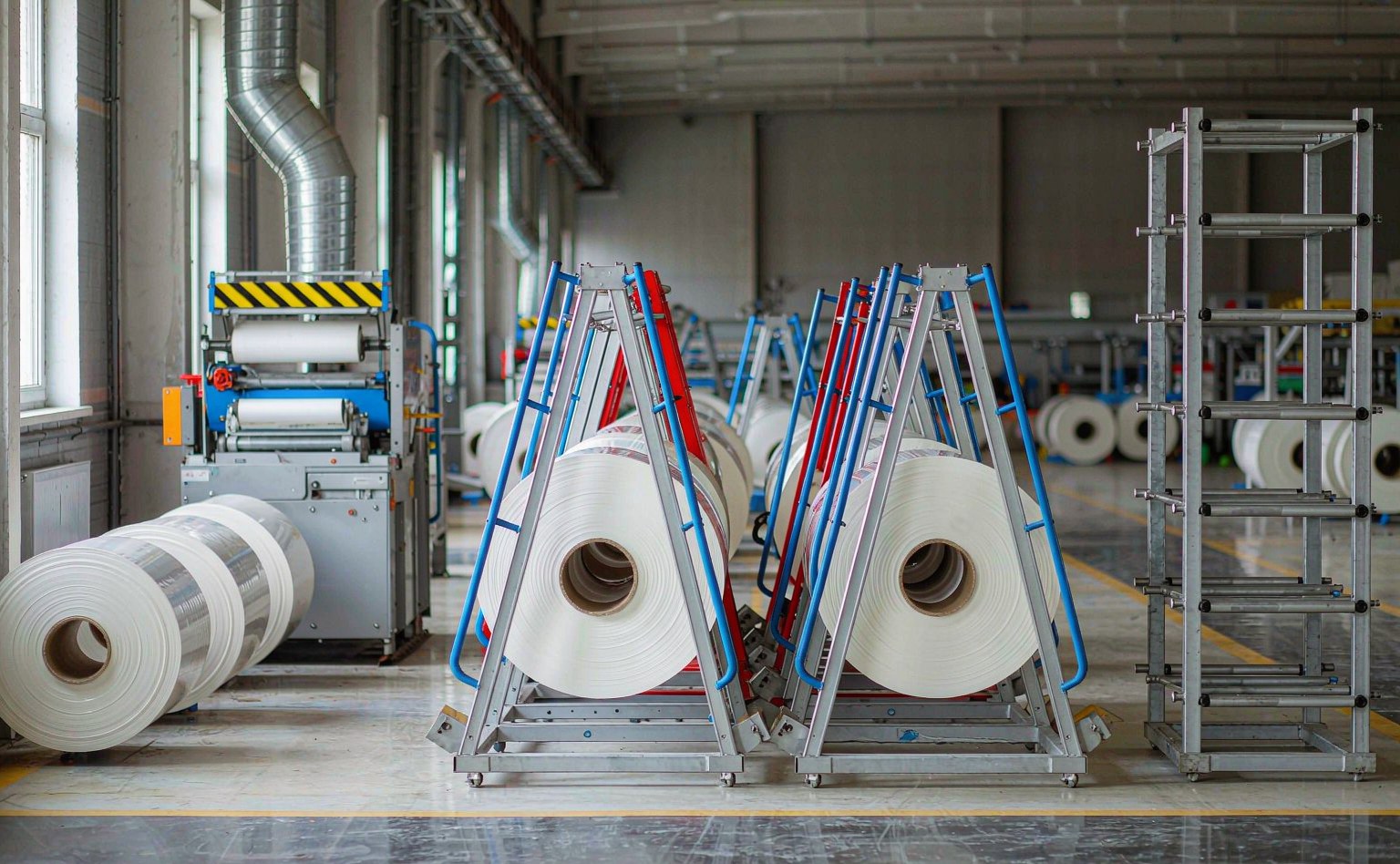
A converting line needs four, and each one is sized by a different logic. The film roll buffer sits between blowing and lamination. It exists because the two stages are measured in different units - kilograms per hour on one side, metres per minute on the other - so nobody can match them by arithmetic alone. The printed reel buffer sits between printing and lamination. It absorbs print runs that are longer or shorter than the lamination batch, and it is where job sequencing is either made easy or made impossible. The cure queue sits after lamination and is the only buffer measured in time rather than in rolls. The core stock sits before slitting, and it is small enough that most plants forget it is a buffer at all - until it runs out.
THE CURE QUEUE IS THE ONE WITH A CLOCK
Solventless lamination does not dry; it cures, and curing is a function of time. That makes the queue after the laminator different from every other buffer on the line: it cannot be compressed by working faster, and it cannot be skipped by working smarter. It can only be given the time it needs. Sizing it is a multiplication rather than a guess. Take the rate at which the laminator produces, multiply by the cure time the structure requires, and the answer is a length of laminate - which converts into a number of rolls, which converts into a floor area. Written that way, the queue becomes a dimension on the layout instead of a habit on the floor. The discipline around it matters as much as the size. Rolls enter at one end and leave at the other, labelled with the time they were wound; the oldest leaves first; nobody shortcuts the queue because a customer is waiting. A slitter fed with under-cured laminate does not fail immediately - it fails at the customer, which is the worst place to discover a scheduling decision.SIZE THE BUFFER IN ROLLS, NOT METRES
Metres are how a line is planned; rolls are how it is handled. A buffer is picked up, moved, labelled and staged one roll at a time, so its real size is a count of rolls - and the roll itself has a physical limit: the blown film line winds to a maximum roll diameter of Φ1,000 mm. A practical rule for sizing is to cover the longer of two events: one changeover at the downstream stage, or one reasonable breakdown response at the upstream one. A buffer smaller than that converts every normal event into a line stop. A buffer much larger than that does something subtler and worse: it hides problems. Work in progress becomes a place where defects wait to be discovered, where rolls are damaged by handling, and where a quality issue that could have been traced to one batch is spread across a week of production.THE CORE BUFFER
Cores look like consumables and behave like a buffer. A Q5-1200 tube cutter cuts a core in half a second, holds its length to 0.01 mm and needs one operator, for tubes between 10 and 1,500 mm long, with outside diameters from 50 to 200 mm and walls of 1 to 20 mm. That speed is exactly why the stock is easy to neglect: the machine can refill a shelf quickly, so the shelf is allowed to run down. The stock has to be organised the way the slitter consumes it - by diameter and length, in the sequence the slitting plan runs, with the oldest used first. A core that is the right diameter but the wrong length is not a partial success; it is a stopped slitter with a full warehouse behind it.


