XIAOPAI · Wenzhou Xiaopai Electric Power Technology Co., Ltd. · Zhejiang, China
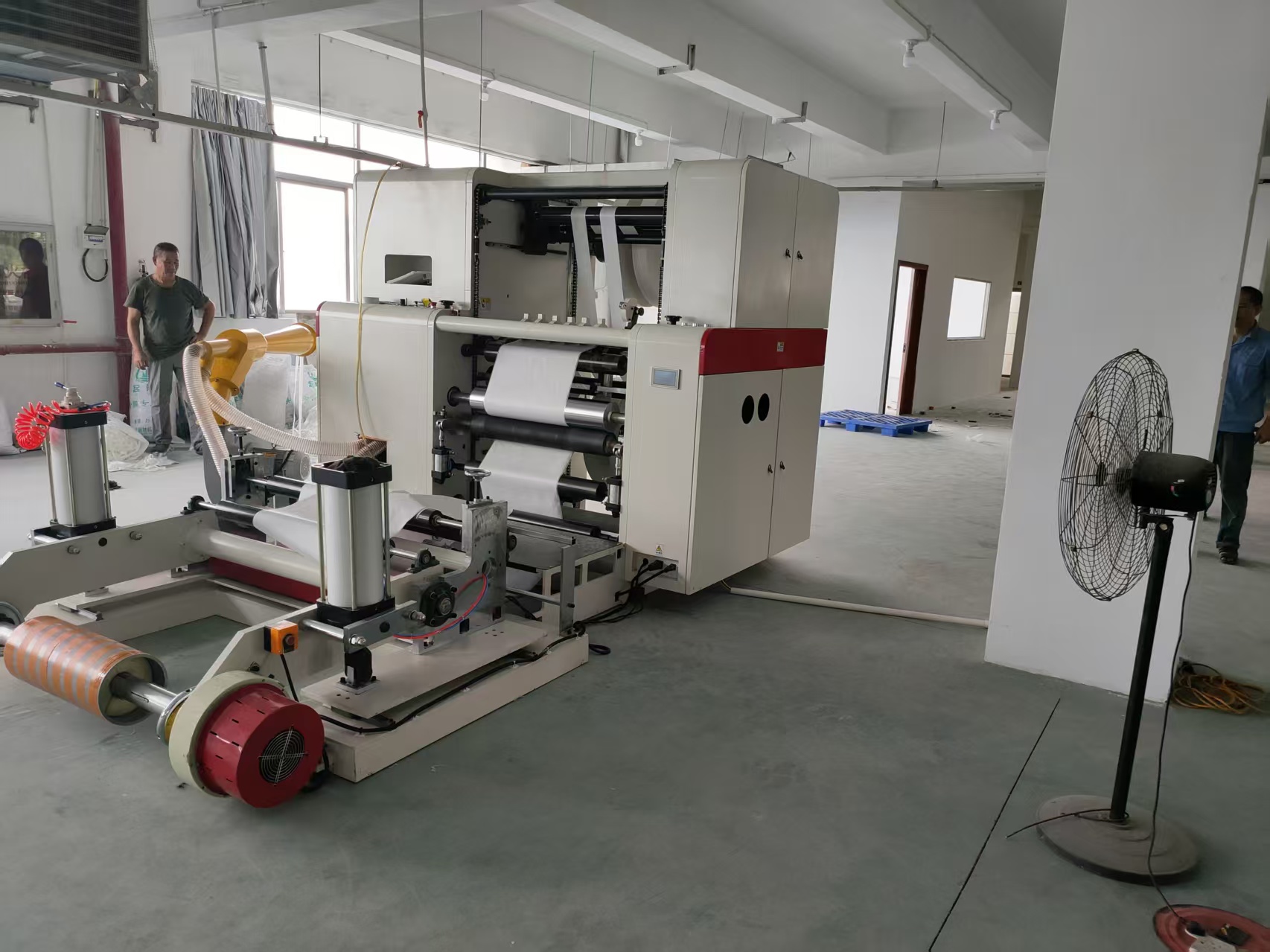
The Type 1300 horizontal slitting machine is rated at 400 m/min, and that is the number every buyer circles first. It is also the least informative number on the machine, because almost no plant runs a slitter at its rating for a whole shift - and the reasons have very little to do with the machine's capability. A slitter's output is decided mostly while the web is standing still: in the knife set, the cores, the trial cut and the check on the first roll. Plants that want more rolls per shift usually find the gain there, not in a faster machine.THE NUMBER ON THE PLATE
A rated speed assumes conditions that a real order rarely provides: a full-diameter unwind, a web without splices or gauge bands, stable tension through the acceleration, and a knife set that is correct for the material in front of it. Take any one of those away and the machine still runs - just not at the number on the plate. Machine launches across the industry are still announced by their rated speed, a new gravure press included, because that is the comparable figure; the plant's own output is a different number entirely. There is also a shape to every set. A slitter accelerates, runs, and then decelerates as the rewind diameter grows and the last metres arrive; the tail of a set is never the fastest part of it. What a plant actually ships is therefore the rated speed multiplied by the share of the shift spent genuinely at speed - and that share is set before the first metre is threaded.
OUTPUT IS DECIDED BEFORE THE WEB MOVES
A changeover on a slitter is not one task; it is six, and only two of them need the machine. Confirm the slitting plan against the customer's widths. Build the knife set. Thread the web. Set tension and guiding. Make a trial cut. Check the first roll. Four of those six can happen while the previous job is still running. The plan can be confirmed at the desk, the knife set can be assembled at a bench, the cores can be cut and staged, and the first-roll criteria can be written on the job card before the machine is free. A plant that treats changeover as a single block - machine stopped, then everything happens - pays for the whole sequence in machine time, every time, on every job.THE KNIFE SET IS A KIT, NOT A CRAFT
In a short-run mix the knife shaft becomes the real constraint: with one shaft, the machine waits for the tool, and the tool waits for whoever is free to assemble it. A pre-assembled set - or a second shaft loaded while the first one runs - turns a setup into a swap, and a swap is measured in minutes rather than in the length of a conversation about which spacer goes where. The kit only works if the set is repeatable. Each configuration deserves a record: the sequence of widths, the spacer stack, the gap or overlap used for that material, and the torque applied to the locking elements. Once that record exists, the same job run next month is a lookup rather than a reconstruction - and the person who assembled it the first time no longer has to be on shift for the job to run correctly. There is a planning lever above the bench as well: every width in a set has to be built, so a plant offering a limited ladder of slit widths assembles fewer sets in a week than one quoting anything a customer asks for. Trimming that ladder by a few millimetres at the edges removes configurations without removing the products the plant can sell.CORES, TAIL AND TRIM
Cores are the quietest cause of a stopped slitter, because they are nobody's machine. The width of each finished roll is the length of its core, so the core requirement comes straight out of the slitting plan - and it changes every time the plan does. A Q5-1200 paper tube cutting machine cuts a tube in 0.5 s to a length tolerance of 0.01 mm with one operator, which means the core stock can follow the plan within a shift instead of being ordered against a guess. The other two ends of the web deserve the same attention. The tail has to be secured so the roll does not unravel in handling, and the edge trim has to have somewhere to go - a trim path that blocks stops more runs than a knife that has lost its edge. Neither is a machine capability; both are decisions taken when the line was laid out and then forgotten.THE FIRST ROLL IS THE GATE
Every set produces a first roll, and that roll decides whether the remaining twenty are worth running. Checking at the end of a set is the most wasteful habit in a slitting department: by the time the fault appears in the last roll, the material, the cores and the machine hours have already been spent. So the check belongs at the start, against criteria written before the run: width inside the tolerance the customer bought, edges clean on both sides, roll face flat without telescoping or starring, and winding firm enough that the roll survives transport. A short reject-code list - five entries, applied at the machine by the operator - turns a defect into a number, and a number is what a supervisor can act on the same day. Nor is precision a private ambition: precision slitting named alongside coatings and material optimization in a recent tea-packaging programme shows how often the finish of a pack depends on this stage rather than on the printing.MEASURE THE PREPARATION, NOT THE MACHINE
Three numbers describe a slitting department better than any speed figure. The first is preparation time per job, measured from the moment the previous job's final saleable roll leaves the rewind to the moment the next job's first saleable roll is wound. The second is first-roll acceptance: how often that first roll passes without adjustment. The third is the re-slit rate - work that has to come back through the machine because it did not meet the order. Tracked by job family, those three numbers show where the ceiling actually is. A plant running many short jobs will find its preparation time dominating and its answer in benches, shafts and staged cores. A plant running long jobs will find first-roll acceptance dominating, and its answer in the settings and the incoming web. Neither answer is a faster machine, and both are quicker to act on than buying one.WHAT XIAOPAI SUPPLIES
XIAOPAI - Wenzhou Xiaopai Electric Power Technology Co., Ltd. - works with a group of long-established Chinese manufacturers to supply the slitting and core-making stages of a flexible packaging line: the Type 1300 slitting machine, rated at 400 m/min, with photoelectric guiding that holds its repeat positioning error to ±0.5 mm, and the Q5-1200 tube cutter for the cores that feed it. The specification conversation covers the two stages as a pair, because a slitting plan and a core supply that disagree will always take more time than either machine can save. The rest of the line - film blowing, solventless lamination, printing and sheet-fed lamination - is supplied on the same terms, with the interfaces named before the order.ONE LINEXIAOPAI - Wenzhou Xiaopai Electric Power Technology Co., Ltd. manufactures oil-immersed and dry-type transformers and switchgear in Wenzhou, Zhejiang, and works with long-established Chinese manufacturers for the flexible-packaging equipment line. Product pages:
Type 1300 slitting machine ·
Q5-1200 paper tube cutting machine.


