XIAOPAI · Wenzhou Xiaopai Electric Power Technology Co., Ltd. · Zhejiang, China
A line renewal is usually planned as a budget and a list, with the lamination stage somewhere in the middle of it. That position is misleading. The laminator is the stage that joins two webs into one, so it decides which structures a plant can sell, how wide the line can run, how long the cure queue has to be, and when the downstream stages may start. Renewing it is less a purchase in the middle of a list than an anchor decision, and the order in which the renewal is planned matters more than the machine's place on the drawing.WHY THIS STAGE SETS THE ORDER
A laminator does not make a product on its own; it makes the condition for everything after it. Fix the adhesive system and a cure window follows, and the slitting schedule has to respect it. Fix a lamination width and the printing plan has to fit inside it, or the printed web has to be slit before it is bonded. Fix the tension architecture and the range of thin structures the plant can run without curl follows from it. A renewal that begins with a machine list tends to end with stages that were each chosen sensibly and fit together poorly. Beginning with the structure envelope reverses the logic: the stage that has to bond those structures is specified first, and the other stages are renewed to meet it. There is a practical reason too. The lamination stage is where a renewal takes longest to prove, because the proof is a bond that has to hold for the life of the pack. A press can be checked against a colour target in an afternoon. A laminate is checked against time, and time is the one thing a renewal week cannot compress.THE SEQUENCE
Step one: the structure list. Three years of structures, by film family, layer count and thickness band - not a wish list, but the jobs the sales team has actually been asked for and turned down. This single page decides whether the renewal is a like-for-like replacement or a change of capability, and it is the only step where the answer is still free. Step two: the width ladder. One ladder covering print width, lamination width and the slitting plan, instead of three separate decisions taken by three suppliers in three months. The ladder is where most renewals lose their coherence: each stage is bought inside its own range, and the ranges do not nest. Step three: the speed balance. The new machine's rated speed has to be read against the stages around it, not against the brochure. A laminator specified far above the constraint stage does not raise output; it raises the queue. Step four: the cure window and the queue. Solventless adhesives cure with time, and the renewal has to provide that time in floor space and in scheduling. A faster machine that feeds a slitter it has to wait for has moved the bottleneck, not removed it. Step five: placement and services. Compressed air, power, exhaust, adhesive storage, web paths in and out. These belong in the renewal file before the machine is ordered, because they are the items that turn a delivery date into a commissioning date. The sequence is fixed because each step constrains the next, and plants that skip a step usually recover it later, in lost weeks rather than in decisions. A relocation makes the order visible in a way a new build does not: when existing lines are taken apart and rebuilt somewhere else, the plant discovers which stage was the hinge - and how much of the line had been compensating for it. Projects like a facility relocation are, in practice, renewals with a deadline attached.THE WIDTH LADDER IN NUMBERS
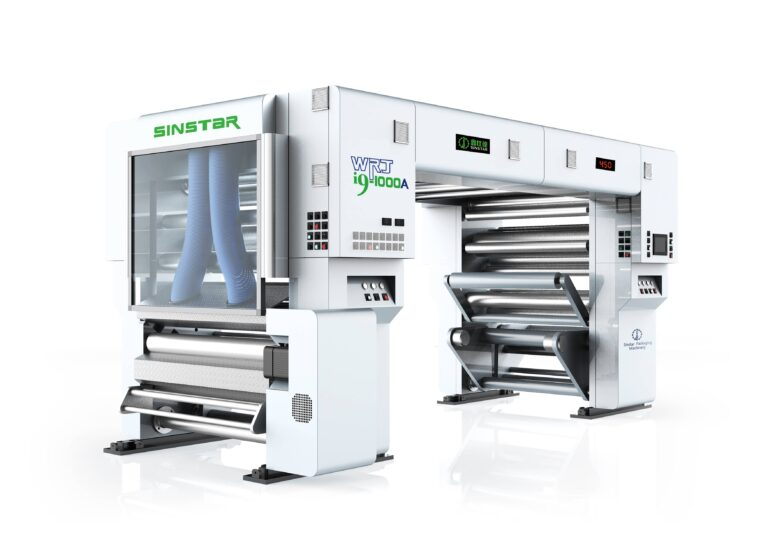
The WRJ Fi9 class reaches 450 m/min and covers lamination widths of 1,050, 1,350 or 1,650 mm; the CI flexo class prints from 100 to 600 mm across a maximum feeding width of 800 mm at up to 150 m/min. Read together, the two ranges already tell a buyer something about the ladder: a printed web narrower than the lamination width is not a defect, it is a combining decision, and the plant has to decide in advance whether that unprinted margin is a product requirement or an accident of purchasing. The slitting plan closes the ladder. A slitter that runs at 400 m/min with photoelectric guiding held to a repeat positioning error of ±0.5 mm, such as the Type 1300, will convert a 1,650 mm laminate into a set of saleable widths - and the number of those widths, not the width of the master roll, is what the customer buys. Width added at the laminator without a slitting plan to use it is width trimmed away twice: once as edge trim, and once as capacity that never enters a shipment.
THE SPEED BALANCE
Set the published numbers side by side - 450 m/min at the laminator, 400 m/min at the slitter, 150 m/min at the press - and the arithmetic of a renewal becomes uncomfortable for anyone who planned to start at the laminator. On many lines the constraint is printing, not lamination. Renewing the laminator to its full rating while the press stays where it is does not ship more laminate; it builds a queue of printed reels waiting for a stage that was never the problem. Two conclusions follow, and they are both useful. First, the honest question before the renewal is which stage will be the constraint after it, not which stage is the constraint now - and the new laminator is specified against that future stage. Second, a lamination renewal can still be the right first move when the constraint is structural rather than mechanical: when the structures the plant needs cannot be bonded at the current width, cannot be run thin without curl, or cannot wait out a cure window that the current control architecture cannot hold.WHAT TO CARRY OVER
A renewal is not a reset. Four things travel from the old line to the new one, and each of them saves a month of relearning. The recipe file comes first. Proven settings for the structures the plant actually sells are worth more than any commissioning programme, and a machine that stores them - the WRJ S1 Digital holds up to 300 job orders - lets the plant migrate that knowledge instead of rebuilding it. The fault log comes second: the failures the old machine produced are the specification for the new machine's options, and a supplier who reads that log before quoting is answering the plant's real history. The wear list comes third, because it becomes the first spare-parts kit. The people come last and matter most - the two operators who know where the tension wanders should be in the training window before the old machine is dismantled, not after.THE QUALIFICATION WEEK
The renewal is not finished when the machine runs. It is finished when the line has run a real order end to end - printed, bonded, cured, slit, wound on the customer's core - and the record exists. That week should test four things in order: bond strength on the structures that matter, register after lamination rather than before it, slit quality at the widths the customer bought, and a full shift at rated speed with the operators who will actually run the line. Facilities that come on stream with their lines specified in this order, such as a new supersite built around installed capacity, tend to discover their interfaces in the planning rather than in the first month of production. The documents are part of the acceptance. Updated drawings, the CE file, a revised maintenance schedule and a spare-parts list with part numbers are what the next renewal will be planned from.WHAT XIAOPAI SUPPLIES
XIAOPAI - Wenzhou Xiaopai Electric Power Technology Co., Ltd. - builds the flexible packaging line together with long-established Chinese manufacturers, and supplies the solventless laminating machine class as SINSTAR's authorized global distributor: the WRJ Fi9 for plants whose renewal is about proven capacity at width, and the WRJ S1 Digital for plants whose renewal is about control, recipes and repeatability. Both are published down to their widths, speeds and stored job capacity, so a renewal can be planned on numbers rather than on impressions. The wider line - film blowing, printing, slitting and tube cutting - is supplied the same way: one specification conversation, with the interfaces named before the order rather than after the installation.ONE LINEXIAOPAI - Wenzhou Xiaopai Electric Power Technology Co., Ltd. manufactures oil-immersed and dry-type transformers and switchgear in Wenzhou, Zhejiang, and works with long-established Chinese manufacturers for the flexible-packaging equipment line. Product pages:
WRJ Fi9 solventless laminating machine ·
WRJ S1 Digital.


