XIAOPAI · Wenzhou Xiaopai Electric Power Technology Co., Ltd. · Zhejiang, China
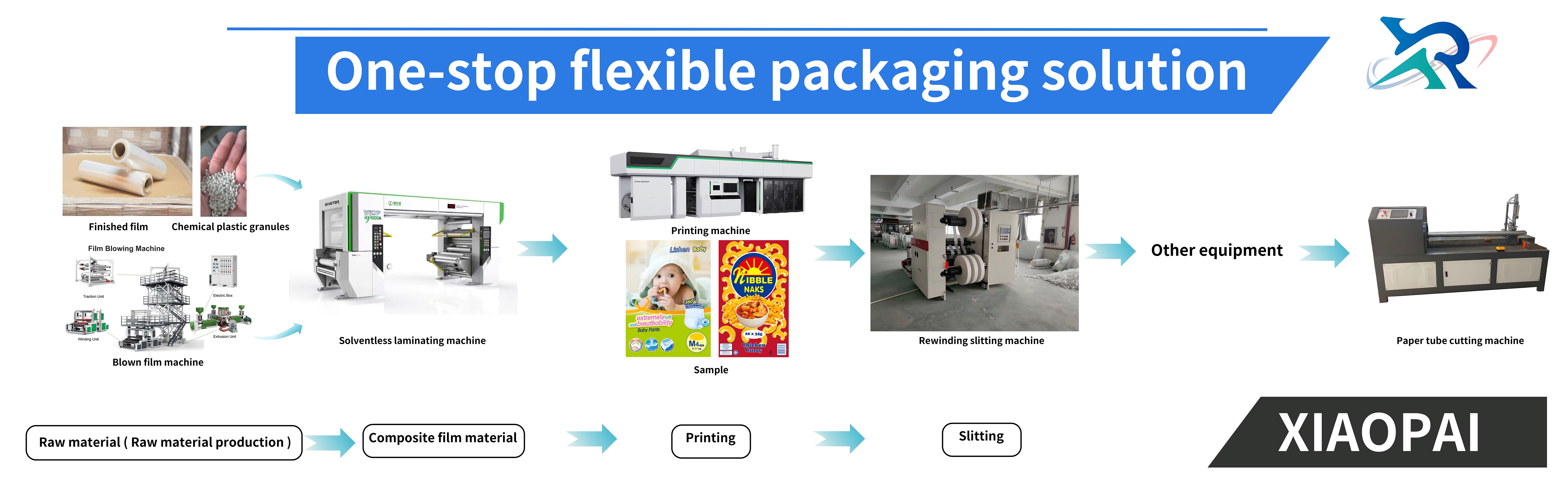
Recyclability has moved from the marketing page to the order sheet: brands that buy flexible packaging are increasingly asked for structures that a recycling stream can actually process, and the industry's answer is the mono-material construction - one polymer family, usually polyethylene, doing the work that polyester, aluminium foil and laminated hybrids used to share. What a procurement conversation sometimes misses is that recyclability is not a property of a film. It is a property of a line. The same blown film machine, laminator, press and slitter that produce a conventional structure have to be set up, fed and tuned differently when the target is a mono-material PE construction - and a supplier who sells the line as one system is the one who can walk a buyer through what changes at each stage. That coordination also shortens the distance between decision and production: when film grades, adhesive settings, ink systems and slitting plans are discussed with one supplier against one specification, a mono-material programme stops being a research project and becomes an order. XIAOPAI, working with long-established Chinese manufacturers, supplies the complete line - film blowing, solventless lamination, printing, slitting and tube cutting - and this guide reads it once more, stage by stage, with recyclability as the specification.STAGE ONE: THE FILM SETS THE CEILING
Every mono-material structure starts at the film blowing machine, because the film decides what the rest of the line can do. On the ABC65/75/65-1800 three-layer co-extrusion line, the material range is already polyethylene-centred - LDPE, LLDPE, MLLDPE and HDPE - running with IBC internal bubble cooling at 100 to 120 m/min and 200 to 300 kg/h of output. That range matters for mono-material work: a PE-based recyclable structure lives or dies by how well the same polymer family performs in the layers that used to belong to other materials - the sealing layer, the stiffening layer, the printing substrate - and a three-layer die lets each layer be tuned for its job while staying inside the family. Blowing those layers in compatible PE grades, with the bubble cooling and gauge control holding thickness where the downstream stages expect it, sets the ceiling for everything after. If the film wanders in gauge or in melt behaviour, no later stage can recover it; if it holds, the laminator and the press receive a web that behaves like a known quantity. The three-layer die is also where the mono-material logic becomes practical rather than aspirational: the inner layer can be optimised for sealing, the outer for print and stiffness, and the core for economy - all in PE grades chosen to stay together in the recycling stream, with surface treatment applied where the lamination stage will need it.STAGE TWO: LAMINATION WITHOUT COMPROMISE
Solventless lamination is the stage where mono-material construction is actually assembled, and PE-on-PE changes the conversation in three ways. The substrate surface, not the adhesive chemistry, becomes the focus: polyethylene surfaces are prepared and treated so the adhesive wets and bonds as designed, and the five-roll coating system on the WRJ Fi9 solventless laminating machine meters that adhesive at the low coat weights solventless laminating is known for - running at up to 450 m/min across 1,050, 1,350 or 1,650 mm lamination widths. Cure behaviour comes second: a mono-material PE laminate does not carry heat and barrier properties the way a foil-containing structure does, so curing conditions are managed with the structure in mind rather than copied from a conventional recipe. Neither adjustment is exotic; both are simply the laminator's parameters being set for the structure the recycling stream will accept - and the machine that meters adhesive precisely at speed is what makes those settings reproducible, shift after shift. Surface treatment belongs in the same paragraph: where the film's surface energy has drifted between blowing and laminating, the treatment stage is re-checked so the adhesive sees the web the way the recipe expects - a small loop between stages that a coordinated line closes internally.STAGE THREE: PRINTING THAT STAYS RECYCLABLE
Printing is where recyclability is most often quietly lost, because ink, coating and laminate together decide whether the finished structure still belongs to one material stream. The CI flexo printing machine in this line is specified for water-based and solvent-based eco inks with photosensitive resin plates - running at up to 150 m/min on a 800 mm maximum feeding width - and that specification is what a mono-material programme needs: decoration applied in a way that stays compatible with the PE stream underneath. The design conversation belongs here too - coverage, contrast and the number of layers of decoration are print-floor decisions with recycling consequences, and they are easier to take when the press, the laminator and the film all come from one coordinated supply. A printed mono-material roll that looks right but carries an incompatible decoration has failed its specification at the printing stage, however good the film and the lamination were. Print position is part of the same decision: in a laminated structure the decoration can sit between webs, protected by the laminate and kept out of direct food contact - a construction detail that mono-material designs preserve, and one more reason the printing and laminating stages are specified together rather than apart.
STAGE FOUR: SLITTING THE SOFTER WEB
A mono-material PE laminate is typically a softer, more extensible web than the foil-containing structure it replaces, and the slitting stage feels that difference first. The line's slitting equipment is specified for it: the rewinding and slitting machine runs at up to 400 m/min mechanical with 0.30 mm EPC correction accuracy, and the horizontal slitting machine holds photoelectric guiding to a repeat positioning error of ±0.5 mm across non-woven, foil, film and paper webs. Softer webs ask for tension profiles and knife setups tuned to the material rather than inherited from the previous product - the same machines, re-parameterised - and the edge quality that slitting delivers is what the customer's own packaging line will judge first. This is also the stage where the line's width coordination pays off: the slitting widths available from the laminated roll are planned backwards from the finished formats, so the recyclable structure converts with the same efficiency the conventional one did. Softer webs reward gentler handling at the rewind as well - tension that tapers through the roll build, and edge quality checked at the finished roll rather than assumed - because a recyclable structure that converts beautifully but winds telescoped has still failed at its last gate.THE CERTIFICATION LAYER
A mono-material construction becomes a marketable recyclable package only when a certification or verification scheme recognises it, and that recognition is organised at the industry level rather than by any single machine. Programmes that verify recycled content and design-for-recyclability keep expanding - certification programmes for recycled content in plastic products are one example - while the collection and processing side scales on policy and investment, as in the case of extended producer responsibility and investment in mechanical recycling. For a buyer, the practical reading is this: the line supplies the structure, the industry scheme supplies the recognition, and the two have to be planned together - which is why the recyclable conversation belongs in the line specification, not after it. The buyer's questions to a line supplier are concrete: which structures the proposed machines have run for recyclable programmes, what changes between a conventional and a mono-material recipe on each machine, and what documentation the line produces to support a later certification file.WHAT XIAOPAI SUPPLIES
XIAOPAI, working with long-established Chinese manufacturers, supplies the complete flexible packaging line - film blowing, solventless lamination, printing, slitting and tube cutting - as one coordinated system, and a mono-material programme is exactly the kind of order where that coordination shows: film grades chosen for the structure, a laminator set up for PE-on-PE, a press specified for compatible decoration, and slitting planned from the finished format backwards. One supplier, one specification conversation, and a line that was designed for the structure the market is asking for next.ONE LINEXIAOPAI - Wenzhou Xiaopai Electric Power Technology Co., Ltd. manufactures oil-immersed and dry-type transformers and switchgear in Wenzhou, Zhejiang, and works with long-established Chinese manufacturers for the flexible-packaging equipment line. Product pages:
blown film extrusion machine ·
CI flexo printing machine.


