


1. TWO FAMILIES, ONE 35 KV RANGE
Everything on this floor steps down from a 35 kV class primary to 0.4 kV for the low-voltage board, and it leaves the factory in one of three forms. The oil-immersed family - S9, S10, S11, S13, S20 and S22 - is a sealed design built around a corrugated tank wall. The dry-type family - SC(B)9 through SC(B)13 - casts its windings in epoxy resin and leaves the works as a bare core-and-coil assembly or dressed in an enclosure. Both ranges are specified, wound, processed and tested in the same buildings, which is why a buyer can compare the two on equal terms instead of comparing two different supply chains. The published rating tables sit on the oil-immersed transformer and dry-type transformer product pages.2. THE CAST-RESIN LINE, WHERE THE COILS TAKE SHAPE
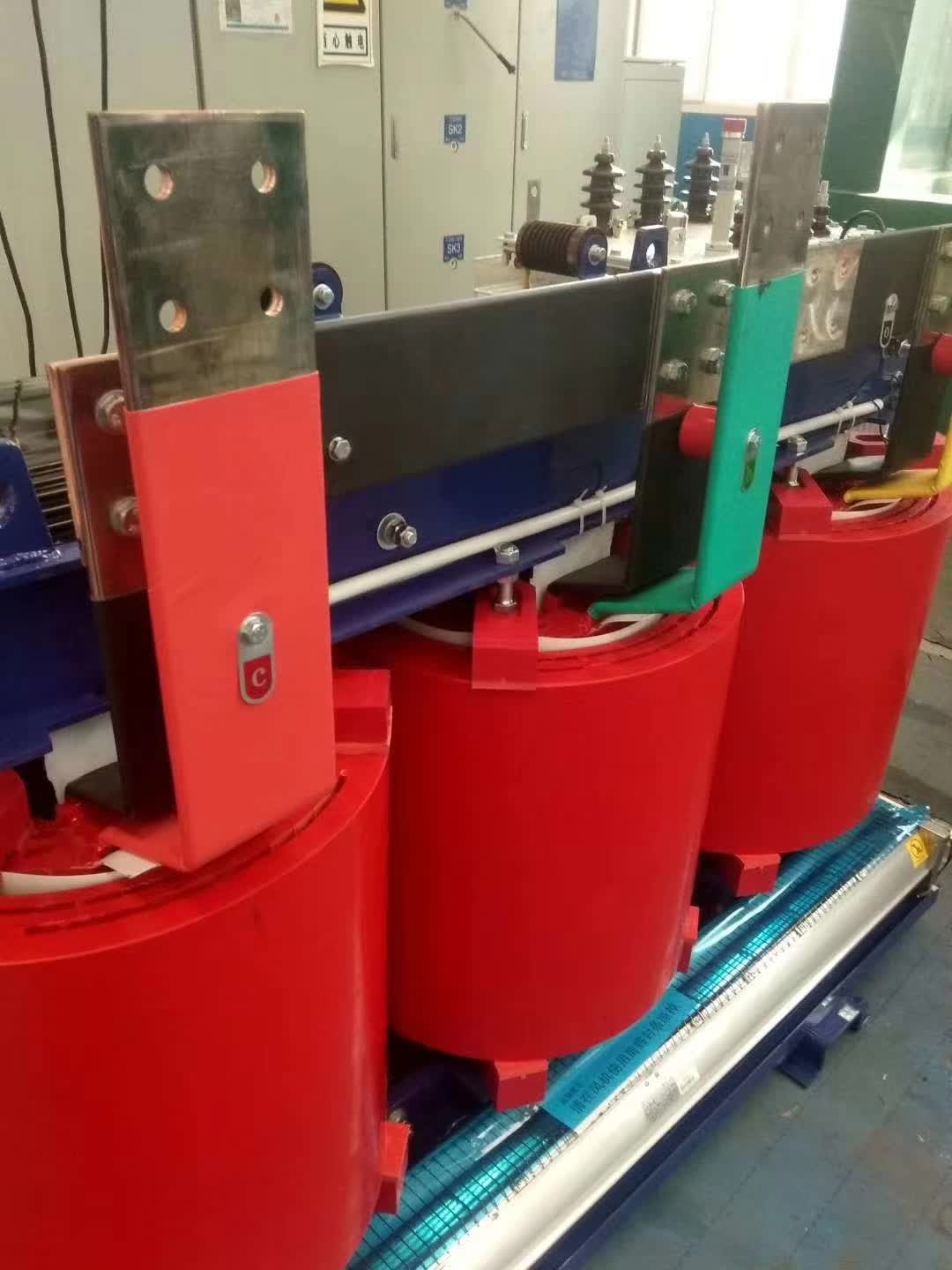
The first photograph shows the point where the dry-type line is most itself. The high-voltage windings are cast under vacuum in epoxy resin, with fiberglass mesh reinforcement over the inner and outer surfaces of the coil. That reinforcement is not decoration: it raises the coil's mechanical strength and its short-circuit withstand, and the casting process is controlled so there are no bubbles or voids inside the resin. The low-voltage windings take a different route. They are foil-wound, which solves the axial alignment problem and distributes ampere-turns evenly along the coil; axial cooling ducts are built into larger units, and DMD resin pre-impregnated fabric sits between layers so the coil cures as one solid body. The sequence on the shop floor is precise winding, vacuum drying, casting, solidification - and each of those steps is monitored rather than assumed. What the casting buys in service is a coil that needs no oil looking after. Cooling is handled by a cross-flow top-blow fan - low noise, high air pressure - and an intelligent temperature controller that raises fault and over-temperature alarms and can trip the unit on overshoot. Under air cooling a unit runs continuously at 140% of rated load, which is the margin a peaking load actually uses. Protection degrees of IP20 or IP23 are offered in cold-rolled or stainless steel, and the LV side leaves through standard busbars with side-entry or top-entry outlets - or a custom connection where the room demands one. Look again at the photograph and the phase identification is already in place: red, green and yellow busbar runs bolted to the upper frame, ready to match the site's connection scheme. From here a unit goes out two ways - bare for mounting inside a panelboard or a substation enclosure, or dressed in its housing for direct installation where the load is.
3. THE SEALED TANK LINE, WHERE OIL MEETS VACUUM
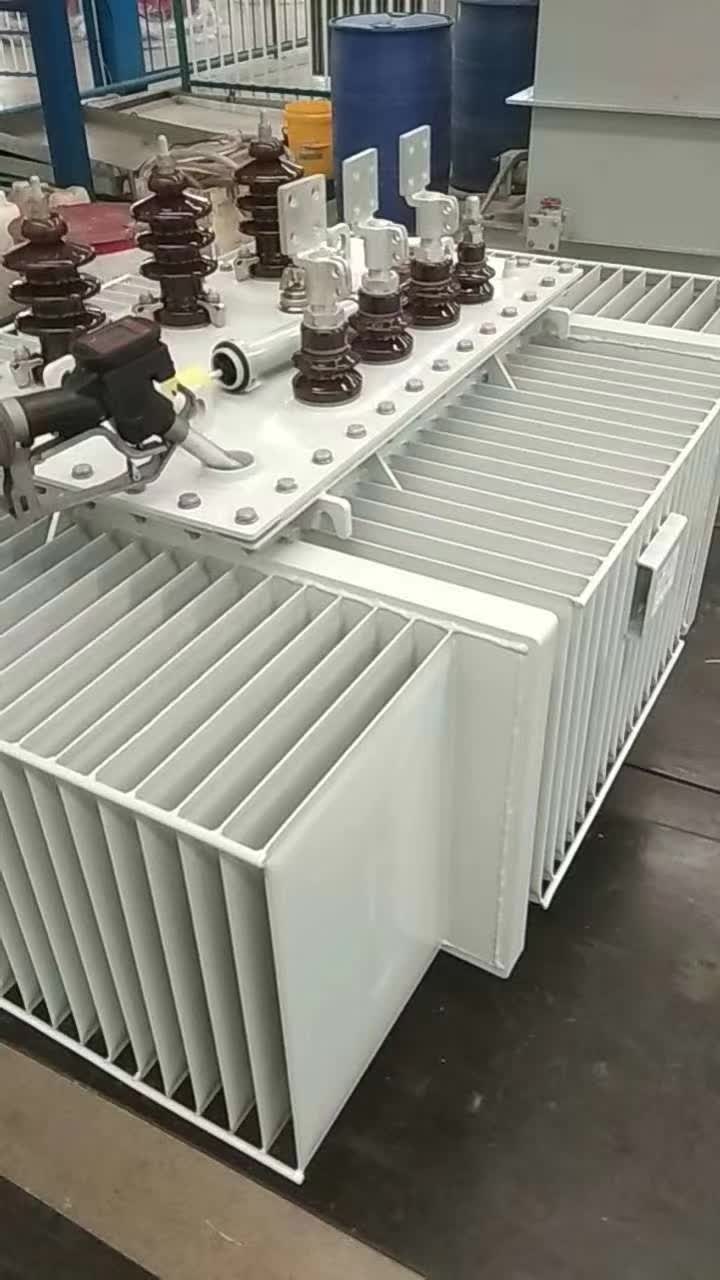
The second photograph is the oil-immersed counterpart, and the corrugated tank wall is doing two jobs at once. The fins cool the oil, and their elasticity lets the tank breathe as oil volume moves with temperature - which removes the need for a conservator and keeps the overall height of the unit down. The tank surface is powder-coated and film-reinforced before it leaves the paint shop. Filling is the step worth watching. Oil enters under vacuum during the sealing process, which drives moisture out of the assembly and keeps the oil from ever contacting air; the finished unit carries oil to an immersion depth of about 120 ± 10 mm over the core and coil assembly. Units rated 1000 to 2000 kVA also carry an outdoor signal thermometer. The pre-dispatch walk-round in the photograph runs through the protective devices as well. Every capacity leaves with a pressure relief valve; a gas relay with alarm and trip terminals is fitted on request. The tap changer is off-circuit - the supply is disconnected before anyone changes a tap - and the bushings, the thermometer pocket and the corrugated wall are each inspected before the tank is signed off for packing. Service conditions close the file on this family: installation altitude up to 1000 m, ambient temperatures from -40 °C to +40 °C, and an order that spells out model, rated capacity, HV and LV voltages with the tapping range, phases, frequency and connection symbol. Those seven entries are what let the works build exactly the unit the drawings describe.
4. THE THIRD EXIT: THE PREFABRICATED SUBSTATION
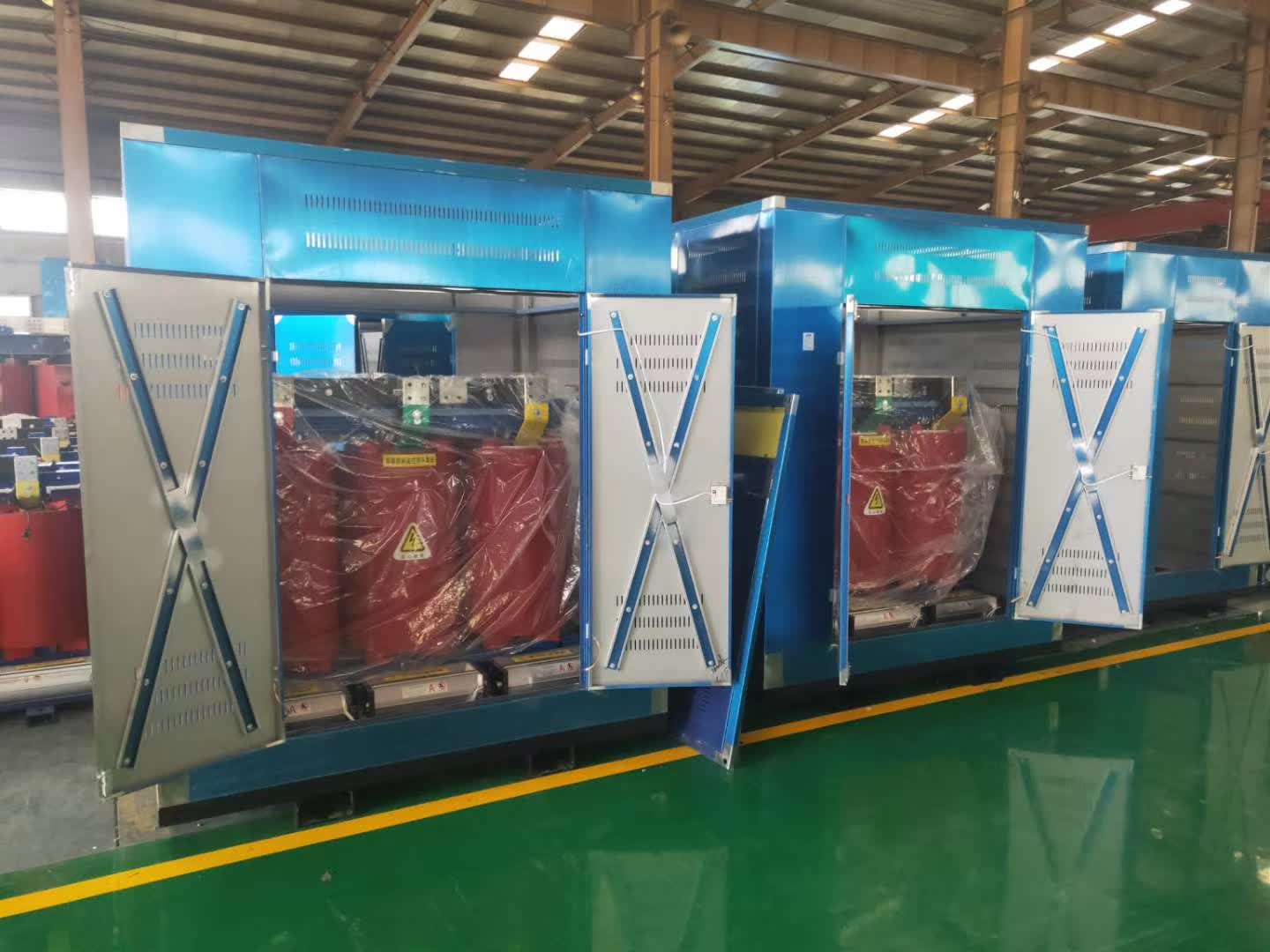
The third photograph is where the two families meet a third product. In a YB prefabricated substation, the dry-type transformer is mounted inside a walk-in enclosure at the factory - the red windings still wrapped in their transit film, cooling louvres cut into the panel work, doors braced open for the final inspection. Integration at the works changes the risk profile of a project. XIAOPAI mounts the transformer, wires the interfaces and completes the inspection before anything is packed, so the transformer, the enclosure and the medium-voltage switchgear arrive as one delivery with one set of drawings and one responsible party - instead of three shipments meeting on site with nobody owning the interfaces between them. The site crew receives a substation that needs foundations, cabling and switching-on, and little else. It is the same logic the packaging industry uses when it buys a line rather than machines - and it is the form that travels farthest per unit of site work.5. WHAT IS TESTED BEFORE DISPATCH
Every unit leaves the works with its own routine test report, written against the applicable IEC standard; type test reports can be supplied per model when the contract asks for them. The routine list is the buyer's evidence, not a formality: ratio and polarity, winding resistance, insulation resistance, the applied-voltage and induced-voltage withstand tests, and - on the cast-resin line - partial discharge. Two of those measurements carry the argument. Impedance voltage and load loss are measured under defined conditions because they decide how the unit behaves when running beside other units and what it costs to feed for the next twenty years; the method is set out at Testing of power transformer - measurement of impedance voltage and load loss . Insulation resistance is the other gate, and on the dry-type line it is taken with the winding temperature as close to 20 °C as practical, with a correcting factor applied when it is not - the procedure is described at Meggering (insulation resistance testing) of dry-type power transformer . Both ranges are CE marked and built under an ISO 9001 quality system. Where a contract calls for it, a third-party inspector can witness the final tests before the units are released for packing.
6. PACKING, DOCUMENTS AND THE PORT
The last form the product takes is a shipping one. Standard export packaging is the rule on both lines, and units sail from Shanghai Port or Ningbo Port. XIAOPAI prepares the paperwork for every dispatch in English - the routine test report, the packing list and the operating and maintenance manual - so the set leaves with the shipment instead of following it. For the dry-type core-and-coil units the packing question is mostly about shock and moisture in transit; for sealed tank units it adds the geometry of a corrugated wall that must not be braced against. Either way, the sequence is the one the photographs tell: windings cast and cured, oil filled under vacuum, enclosure integrated, tests witnessed, film and crating applied, and the unit measured onto transport that has already been chosen around its weight. That is the whole distance between an order confirmation and a dispatch photograph - and on this floor it is a distance a buyer can walk, audit and hold the reports for.XIAOPAI - Wenzhou Xiaopai Electric Power Technology Co., Ltd. manufactures oil-immersed and dry-type distribution transformers, and integrates YB prefabricated substations, in Wenzhou, Zhejiang, and works with long-established Chinese manufacturers for the flexible-packaging equipment line. Product pages: dry-type transformer · oil-immersed transformer .


