XIAOPAI · Wenzhou Xiaopai Electric Power Technology Co., Ltd. · Zhejiang, China
Pick up a core that has just come off a paper tube cutting machine and look at its end face. Everything the blade did on that last stroke is recorded there - the sheared band, the edge quality, the squareness of the cut. The end face does not flatter anyone, and read across a shift it will tell you where the blade is in its working life long before anything stops. A core room runs through thousands of cuts a day, and the blade is the one part that touches every single one of them. Everything else on the machine - the servo feed, the pneumatic stroke, the PLC logic - exists to place the tube for that blade and take it away again. Which is why blade care is not a maintenance afterthought on a paper tube cutting machine. It is where quality is decided first.1. WHY PAPER TUBE IS HARD ON AN EDGE
Spiral-wound paper tube is not a soft material. It is built from multiple plies of paper bonded with adhesive, and depending on the grade it carries fillers and coatings that are abrasive by nature. Cutting it is closer to machining a composite than to slicing a sheet of paper. The layout adds to the demand. On the Q5-1200 paper tube cutting machine the tube rotates and the knife does not - a single blade held against a workpiece that spins. Every cycle is interrupted contact: an entry, a shear, an exit, repeated thousands of times a day. And one edge absorbs everything the core room throws at it. Tubes run from 50 to 200 mm in diameter and 1 to 20 mm in wall thickness; finished core lengths are cut anywhere from 10 mm spacers to 1,500 mm sleeves. Diameter changes move the contact geometry, wall thickness changes the load, and some paper grades are simply harsher than others. The published data is honest about one of these variables: the 0.5 second cut carries its own footnote - it changes with thickness.2. THE CUT FACE IS A READOUT
Blades do not fail suddenly in this job. They lose sharpness gradually, and every stage of that decline leaves a signature on the core end. The useful skill is not measuring blade wear - it is knowing which face tells you what. A fine burr or a rolled lip is the first honest signal. The edge has stopped shearing cleanly and started pushing material ahead of it, and the evidence survives on the end face. Burrs matter beyond the core itself: the first film layers wound onto a core sit directly against that cut edge, and a lip that stands proud prints itself into the roll. A pale, glazed band along the cut - fibre that looks polished rather than severed - points to friction heat. The edge is rubbing its way through instead of cutting, and the paper is being burnished by the passing blade. Ends that no longer sit square against a straightedge tell a different story, and it is worth being precise about which: squareness drift can come from the blade, from the clamping that holds the tube, or from feed behaviour if the tube moves during the cut. The cut face is the evidence; the cause sits somewhere upstream of it. Dust is the loudest signal. Paper dust is always present in a core room, but a visible jump in it means the edge has crossed from cutting into abrasion - the same machine, the same rhythm, more debris. Length scatter usually arrives next. The servo positioning still holds its cutting resolution down to 0.01 mm, but the material being cut starts deciding the result: a dulled edge behaves differently at hard adhesive lines, and cores from the same batch measure differently at the end of a shift than at the start. The machine's precision is intact; the variable has moved into the cut. And at the far end of the curve, crushed or oval tube ends appear. A tired edge needs more force to get through the wall, and that force lands on the tube itself. None of these signals needs an instrument. A shelf of sample cuts - one per run - plus a straightedge and decent light will do it. What matters is reading them the same way, every time.
3. WHAT A WORN EDGE CHANGES
There is no alarm for a blunt blade. The machine keeps cycling at the same rhythm, keeps holding the same length, keeps stacking cores - the process looks under control while its output quietly changes. That is the trap: blade wear does not stop production, it degrades what production means. Cut quality goes first, then dust levels in the room, then the length consistency the downstream process assumes. The converting floor keeps its own scoreboard - consistent results, reduced waste, fewer interruptions - and it is a scoreboard that equipment builders now design toward, as the connected, automated production demonstrated at the recent LOUPE Americas show illustrates. A cutting edge is where that consistency is decided first, because the roll, the print and the pouch all inherit whatever the core room finished with.4. THE CARE ROUTINE
A blade routine for a tube cutting machine is short enough to survive a busy month. Three habits carry it. Read every shift's cut. One core from each production run, taken to a bench and checked against a straightedge under good light, is a thirty-second habit that catches wear while it is still cosmetic. Replace on signals, not on the calendar. Calendar-based changes swap out good edges and keep tired ones, because blade life in this job is not one number - it moves with the paper grade, the wall, the diameter and the duty. The cut face and the dust tell you when the edge has crossed the line. Keep a simple log. Which blade, which batch, when changed, and why. After a few months the log turns guesswork into pattern: the paper grade that eats edges, the product that demands a finer finish, the shift where setup discipline slips. It also upgrades blade care from an emergency into a managed spare part - and the supply side matters here, because a blade programme is only as good as its spares channel. XIAOPAI stays the single point of contact after delivery, coordinating technical support and spare parts with the manufacturing side.5. WHAT SHORTENS BLADE LIFE
Blade life on paper tube cutting is not a fixed figure, and a number quoted without conditions is worth less than the paper it is printed on. What can be named is the list of factors that move it. The tube sets the duty: wall thickness and diameter decide how much material each stroke cuts, and heavy walls at large diameters load the edge hardest. Filler content, recycled fibre share and adhesive lines vary the abrasiveness from one paper batch to the next. The rhythm sets the pace: a line cutting continuously at 0.5 seconds per cut through a full shift packs an enormous number of contacts into every working day, and the edge simply sees more work than the same blade in an intermittent job shop. The setup decides how the edge is used: clamping force and feed behaviour determine whether the blade shears the paper or scrapes across it, and a tube that shifts slightly during the cut works the edge unevenly - and shows up later as squareness drift. The room has its say too: airborne paper dust is abrasive, and keeping it managed keeps it away from the machine's moving elements and off the cut itself.6. WHERE THE MACHINE MEETS THE BLADE
Start with the machine that holds the edge. The Q5-1200 paper tube cutting machine - the unit behind most of this article's numbers - reads like this on its specification: tubes from 10 to 1,500 mm long and 50 to 200 mm in diameter, wall thickness from 1 to 20 mm; a single-knife layout where the tube rotates and the knife stays fixed; pneumatic feeding with servo speed control; one operator; each cut in about 0.5 seconds, subject to thickness; a positioning servo with precision ball screw drive, cutting resolution down to 0.01 mm; PLC control with a colour touch-screen, automatic shutdown and system self-diagnostics. The mainframe measures 2,300 x 750 x 1,800 mm and weighs 800 kg. That specification matters to blade care because the machine defines the interface the edge works inside - what it cuts, how fast, and with what repeatability. It also matters that the maintainable side is documented: units ship with an English operation and maintenance manual, CE-marked electrical panels and ISO 9001 quality-system documentation, and the service side of the converting equipment world keeps deepening in parallel - finishing equipment makers now operate dedicated flexible packaging centers of excellence, because uptime and cut quality are what equipment buyers actually evaluate. The Q5-1200 comes through XIAOPAI's flexible packaging route - equipment sourced from the long-established Chinese manufacturers it works with - and the paper tube cutting machine is one of the families that route carries. The contracting party behind that supply is Wenzhou Xiaopai Electric Power Technology Co., Ltd., trading as XIAOPAI. Full specifications sit on the paper tube cutting machine page.7. THE BLADE FEEDS THE SLITTING LINE
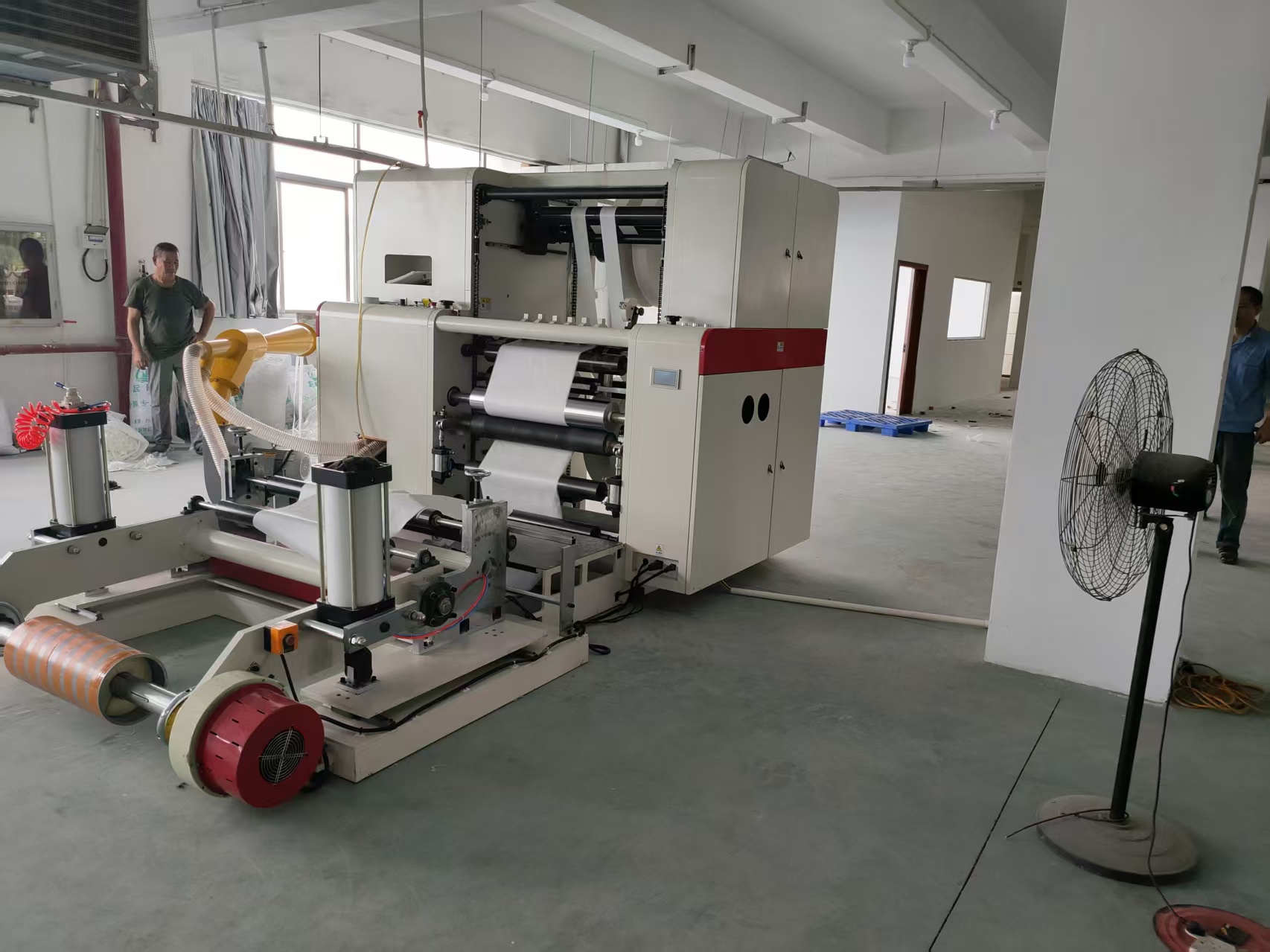
A core room's output does not sit on a shelf. It rolls straight into the converting line and onto slitting and rewinding machines, where every finished roll of film, foil or laminate is wound onto a core that the tube cutter produced. Cores and slitting lines belong to one chain, and XIAOPAI supplies across it - the paper tube cutting machine and the slitting machine included. The slitting machine sets the pace of that consumption, and the cores it receives have to arrive square, burr-free and consistent - because the slitter cannot fix a core, it can only wind onto it. Which is what blade care is really protecting. A clean cut face gives the rewinding process a true mounting surface. A square core keeps film edges aligned roll after roll, through every downstream stage - printing, lamination, pouch-making, filling. And the customer complaint that never happens is the return on a thirty-second shift check. Blades are consumables, and the word hides what they really are: a process variable. On a paper tube cutting machine the cut face is the instrument, the routine is the method, and the edge - sharp or not - writes the first line of every roll's quality record.ONE LINEXIAOPAI - Wenzhou Xiaopai Electric Power Technology, Co., Ltd. manufactures the power transmission equipment line in Wenzhou, Zhejiang, and works with long-established Chinese manufacturers for the flexible packaging line, supplying the paper tube cutting machine above. Relevant pages:
paper tube cutting machine ·
slitting machine.


