XIAOPAI · Wenzhou Xiaopai Electric Power Technology Co., Ltd. · Zhejiang, China
A solventless laminating machine has no drying tunnel, and that single fact shapes everything between its arrival on site and the first roll that passes inspection. There is no heated run of web that forgives a poor start, so the machine has to be right before it runs - not corrected while it runs. The work that makes it right follows a sequence: site, connections, assembly, cold checks, first adhesive, first roll, handover. It is short compared with the years of service behind it, and it decides how those years behave. XIAOPAI is the trading name of Wenzhou Xiaopai Electric Power Technology Co., Ltd., the authorized global distributor for the solventless laminating machines built by SINSTAR (Chongqing), and works with long-established Chinese manufacturers across the flexible packaging line. This article follows the commissioning sequence of the WRJ range, from the layout drawing to the handover file.1. THE FLOOR PLAN IS THE FIRST DELIVERABLE
An installation begins as a drawing. Working width - 1,050 to 1,650 mm across the range - film structure, output target and the units that will run inline get settled against the plant layout at the enquiry stage, and XIAOPAI asks for site conditions up front so that the drawing that comes back matches the floor it will sit on. A plan agreed in advance turns commissioning into confirmation; a plan skipped turns it into improvisation with a forklift. Two of the checks belong to the building itself. The route in: the largest assemblies travel separately, and they have to pass through doors, corridors and turning circles that were designed for pallets, not for a coating station. And the floor under the machine: a laminating line is a chain of heavy stations, each carrying its own load, and where the subsoil or the slab is questionable the answer is a foundation pad planned before delivery. The time to catch a levelling problem is before delivery - caught after installation, it turns into rework. The rest of the survey belongs to the machine. Reels run up to 800 mm diameter on the unwind and 800 to 1,000 mm on the rewind of the WRJ range, loaded shaftless onto 3+6 inch cores - so the working envelope at each end has to let a full reel in, and let it out again, without threading a path through the operator's standing room. Power routing and lighting are settled on the drawing for the same reason. And the material store deserves a moment: films, foils and the two-component adhesive all live better under stable conditions, and the adhesive should be stored to its supplier's instructions from the day it lands. Capacity gets added across the industry on this pattern all the time. A plant expansion reaching completion in Europe is the same sequence seen from the other end: building first, equipment second, production last.2. WHAT THE BUILDING OWES THE MACHINE
The solventless process deletes an entire utility from the project. There is no drying system to install, no solvent storage area to build, no exhaust ducting to route: the machine that removes the drying tunnel from the line also removes a construction list from the building. What remains is electrical, and that is where the checks concentrate. The first check happens before anything is energised - the supply available on site against the machine nameplate and the electrical drawing. Voltage, frequency and phase alignment are confirmed by the electrical contractor; the earth is verified to the drawing's specification; the control circuits are insulation-tested before the controllers ever see power. Ordinary steps, worth doing to an ordinary standard of care, because what hangs off the supply on a line like this is not only motors. The tension controllers, the metering pump and the edge guides are electronics, and electronics want clean power and a solid earth. The time to verify that is before the first reel - not after the first mysterious fault.3. REBUILDING THE LINE ON YOUR FLOOR
After transit, the machine exists as stations: unwind, coating unit, laminating nip, rewinder, splicer, edge guides. Commissioning puts them back in order, and the order matters less than the alignment. A coating station is at heart a set of rollers whose job is to leave adhesive of one thickness across the full web width, and how parallel those rollers sit - how the gaps between them are set - is what the web will show for the rest of the machine's life. The coating unit of the WRJ range carries a five-roller system, and the adhesive reaches it through a gear pump with automatic ratio control, plus de-gassing and viscosity control. Each element is checked in place: pump coupling and pipework free of leaks, metering line primed and free of air, the rollers turning true against the web path. On the WRJ S1 Digital the station is built around a three-roller back-pressure design and a tungsten carbide coated roller specified for about five times the wear resistance of the standard part - hardware that keeps the geometry stable, provided the geometry was set right to begin with. The shaftless loading system at each end gets its own inspection: travel, locking, and the alignment that decides whether a reel seats square on the first attempt or fights the operator every time after.4. THE COLD CHECK
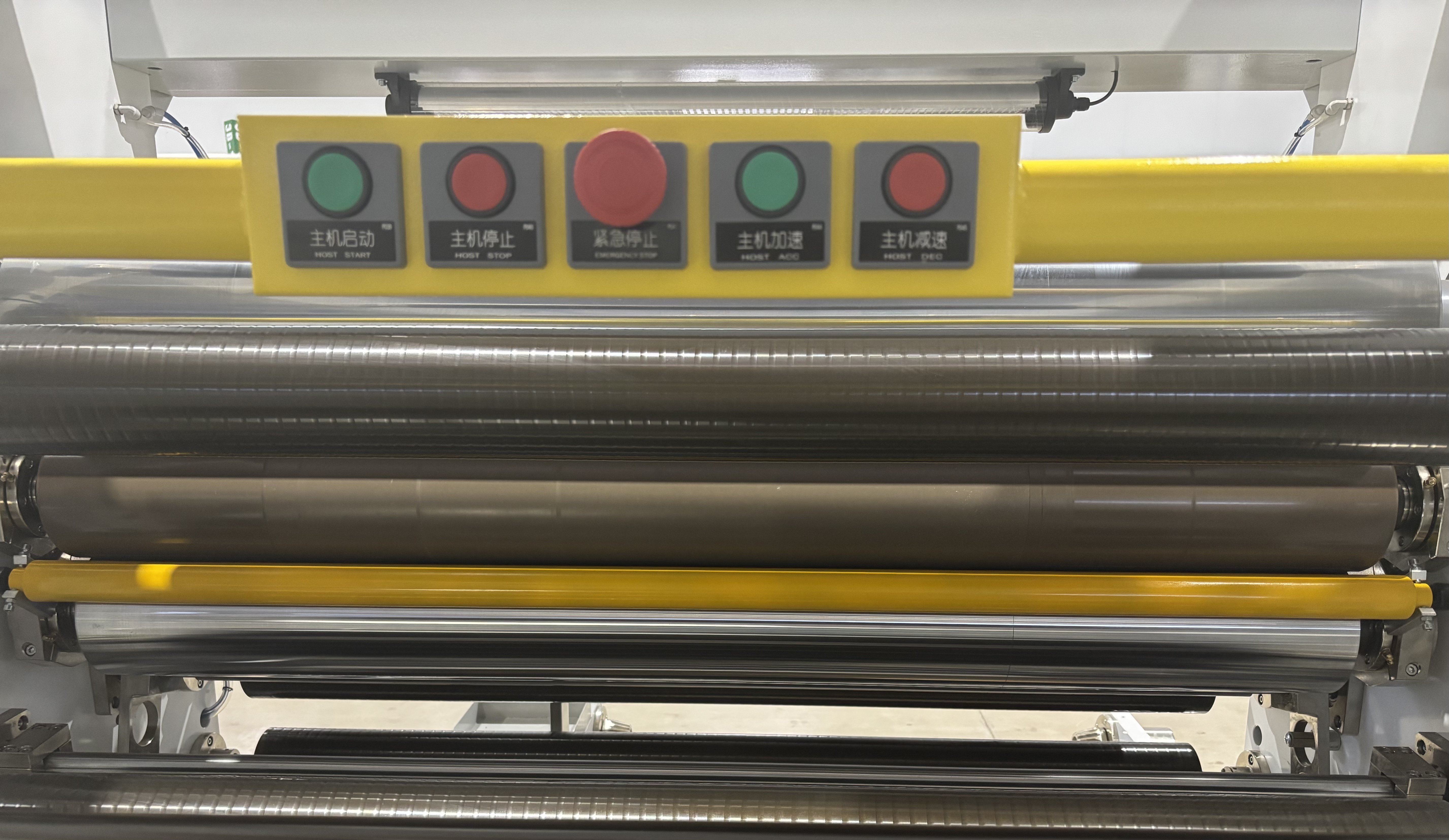
With power on and no adhesive anywhere in the system, the machine is walked through every motion it owns. The trade calls it a dry run, and it runs in a deliberate order: single actions first - direction of rotation, nip open and close, reel lift, splicer arm - then the closed loops. A closed loop is only closed when three things agree: the sensor reads, the controller responds, and the brake or motor acts. The WRJ range runs closed-loop tension on each nip, and commissioning is where each loop is walked end to end - sensor wiring, controller response, actuator force - before a single metre of product is attempted. The same walk applies to the edge guides and the automatic splicer: prove the sensing, prove the correction, prove the return. Only when every motion is boring does the machine deserve material.
5. FIRST ADHESIVE
The adhesive system gets its own first day. The gear-pump metering system is primed and confirmed for ratio control; de-gassing and viscosity control are checked against the adhesive the buyer will actually run - and that match matters, because the WRJ machines are set up around the two-component PU chemistry at the 100% solids formulation the solventless process is built on. Coat weight anchors the first run. The published working range is 1.0 to 5.0 grams per square metre, and the first passes are not about hitting a target in one move: they are about confirming that a setting lays adhesive evenly across the full web width, at a speed low enough to watch it happen. Only then does the line begin to climb. The mechanical envelope - up to 450 m/min on the i9 class, 500 m/min on the WRJ S1 Digital - is not a starting point. Production speed is normally 70 to 85 percent of the mechanical figure, and the first week belongs to the lower half of it.6. THE FIRST ROLL IS THE ACCEPTANCE TEST
The first roll off a commissioned machine carries three questions, and the answers are read in three places. The coating: adhesive weight sampled against target and spread checked across the width - the same uniformity the five-roller station was aligned for. The bond: the composite inspected for the defects that mean a bad start rather than a bad recipe - spots, streaks, or a delamination line that tracks something in the machine rather than something in the film. Nothing in a solventless process averages out a patch of light or heavy adhesive, which is exactly why the first roll is inspected slowly. The rewind: a roll built to 800-1,000 mm diameter on a 3+6 inch core, wound at the taper the machine's intelligent control sets. A roll that goes slack near the core or telescopes at the edge is a commissioning conversation, not an operator error - it tells the team something about taper or tension that belongs to the handover, not the running crew. Meanwhile the speed walks upward. The point is not to prove the machine can reach its ceiling - the machine proved that at the works, in factory acceptance testing before dispatch, with third-party inspection available on request. The point is that this machine, on this floor, with this film, holds coat weight and bond quality as the speed rises. The first roll is the site's own acceptance. When it passes, the machine stops being a delivery and starts being capacity - a scene repeated across the industry every time new output arrives a line at a time, like a new cast film line entering production in Mexico.7. HANDOVER: THE FILE AND THE CHANNEL
The last stage of a commissioning has less to do with the machine than with the record: the files, the training and the responsibility that change sides at the end. It takes an afternoon, and it is easy to do badly. Operator training belongs in the commissioning week, while the first faults are still interesting: reel loading, coat-weight settings, changeovers between structures, and the alarm list - taught on the machine that will actually run, not from a slide deck. The documentation comes with the shipment - CE marking, ISO 9001 company certificate, routine test reports, packing list, certificate of origin and an English operation and maintenance manual - and it becomes most useful in one further step: when the test records are filed against this machine's own first-roll results, so the baseline for troubleshooting next year is the accepted state, not a memory. The channel stays open after delivery. XIAOPAI is the single point of contact, coordinating technical support and spare parts with the manufacturing side, so a question about a roller, a recipe or a spare goes to one address instead of a chain. The WRJ range in this article - built by SINSTAR (Chongqing) and supplied by XIAOPAI as authorized global distributor - sits inside the wider flexible packaging line that XIAOPAI works with long-established Chinese manufacturers to deliver. Full specifications live on two pages: the solventless laminating machine page for the range as a whole, and the WRJ i9 solventless laminating machine page for the i9 class. Commissioning is not an interval between delivery and production. It is the first production decision the plant makes.ONE LINEXIAOPAI - Wenzhou Xiaopai Electric Power Technology, Co., Ltd. manufactures the power transmission equipment line in Wenzhou, Zhejiang, and works with long-established Chinese manufacturers for the flexible packaging line, supplying the solventless laminating machine range from SINSTAR as its authorized global distributor. Relevant pages:
solventless laminating machine ·
WRJ i9 solventless laminating machine.


