1. WHY THE SOLVENTLESS PROCESS NARROWS THE TENSION WINDOW
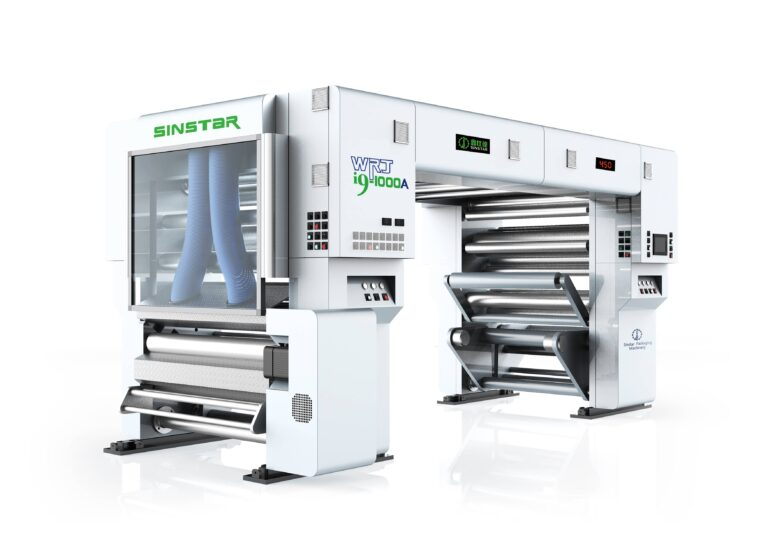
On a solvent-based line, the drying tunnel gives the web a long, tensioned path between coating and rewinding - a stretch in which the machine can stabilise what the coating head started. A solventless line has no such stretch. The adhesive transfers at the nip and the structure is complete in one pass: whatever condition the two webs arrive in is the condition they are bonded in. Bond strength is usually discussed as a matter of chemistry, and chemistry is half the story. The industry's own reading of what makes a bond survive starts with what the surfaces bring to it - see why primers play a key role in packaging coatings - and then assumes even, consistent contact between web and adhesive. Even contact is a mechanical condition. It requires the adhesive to be metered evenly, the work done on the WRJ i9-1300A by a precision gear-pump metering system with automatic ratio control, de-gassing and viscosity control. And it requires the two webs to arrive at the nip flat, aligned and at stable tension. An error in adhesive weight shows up in a lab test; a web arriving slack on one edge is already a reject in the making, whatever the coat weight says.2. FOUR TENSION SYSTEMS, ONE LAMINATING LINE
A laminator is not one tension problem. It is four, and each of them fails in its own way. The unwinders hold reels that start at up to 800 mm in diameter and end near their cores. As a reel drains, its inertia and the torque needed to turn it change continuously, and keeping the web steady through that change is the unwind controller's whole job. The coating nip is where the two webs trade separate lives for a shared one, and it is the point the WRJ i9 family compresses into one specification line: closed-loop tension on each nip. That line deserves reading slowly. Closed-loop means the controller measures what the web is actually doing and corrects it, rather than holding a setpoint and hoping the mechanics agree. On each nip means every web junction has its own loop - because the right tension for a thin film and the right tension for aluminium foil are not the same figure. The splicer is the fourth system, and the loudest. An automatic splicing sequence joins a new reel at running speed, and for the seconds it takes, two webs compete for one tension zone. Machines that hold through the splice are the ones where the next roll starts clean instead of starting with a soft patch. And surrounding all four, the speed question. The published 450 m/min on the WRJ Fi9 and i9 platforms is a mechanical figure; on these machines, real production speed usually lands at 70 to 85 percent of it once the structure, the coat weight and the changeover pattern are counted. The gap between the two numbers is made of the settings - tension among them - that hold the process stable. Speed is earned by the tension system, not asked of it.3. THE REWIND ROLL IS A STRUCTURE
A finished laminate roll looks like storage and behaves like a structure. Every new wrap goes on over the wraps before it and presses them a little tighter; without intervention, a roll wound at constant tension ends up with its outer layers crushing the inner ones - the core region baggy, the edges starting to bulge, and the defect buried where no final inspection will find it. The fix is taper: the winding tension reference falls as the roll grows, so each wrap joins the structure slightly softer than the wrap inside it. It is a curve, not a number, and it is one of the places where newer machines visibly part company with older ones. The WRJ S1 Digital manages it digitally - intelligent rewind taper control, on a 1,350 mm web winding to 1,000 mm rolls at up to 500 m/min - and pairs it with a swing-arm tension linkage and adaptive tension control that track the reel as its diameter changes. The effort is not cosmetic. A roll with hard and soft bands rarely fails in lamination. It fails at the next process - slitting, printing or bag making - which is where winding quality is finally audited, by people who did not run the laminator.4. WEB GUIDING: THE HORIZONTAL HALF
Everything so far is the longitudinal half of web control: how hard the webs are pulled. The other half runs sideways. Guiding - the lateral position of each web - gets a fraction of the attention tension gets, and produces its own family of rejects when it drifts. Two webs that reach the nip with a lateral offset create a different class of defect. The laminated edge no longer sits where either film's edge expects it: one surface carries adhesive where it should carry nothing, the joined edge starts to curl, and the trim that the slitter later removes has to grow to find clean film on both sides. The further downstream the problem is found, the more expensive it is. Edge guiding is the system that holds the line. Position sensors watch a web edge, and a steering correction - applied at the reel or at a guide roller - shifts the web back towards its line continuously. On the WRJ range, automatic edge guiding arrives as part of the automation packages alongside recipe memory. And width matters: across a 1,650 mm web, lateral errors have more span to accumulate across than on a 1,000 mm machine, which is one reason wide lines specify guiding as carefully as tension.5. THIN FILM AND ALUMINIUM FOIL: THE NARROWEST CASE
If you want to know why a machine's tension specification is written the way it is, look at the substrates it calls out. The WRJ i9-1300A states its closed-loop loop as critical for thin film and aluminium foil; the high-speed WRJ Fi9-1300A states the same loop tuned for thin film and aluminium foil at speed. Those two materials are the examination at the end of the tension chapter. Thin films have little reserve: a given percentage error in pull is a larger real error in the film's travel, and the film forgives less before it wrinkles or stretches. Aluminium foil has no elastic reserve to speak of - it is a barrier layer that does not stretch and does not recover - so a tension event that a sturdier film would ride out becomes a crease the finished structure keeps. At speed, both effects compound. Higher line speed shortens the time every controller has to react, and raises the energy in every contact between web and roller. That is why the i9 and Fi9 platforms advertise their tension loops as headline features, and why the S1 Digital puts "more precise tension control" in its opening line. At 450 to 500 m/min, the tension and guiding systems are doing the most delicate work on the machine.