XIAOPAI · Wenzhou Xiaopai Electric Power Technology Co., Ltd. · Zhejiang, China
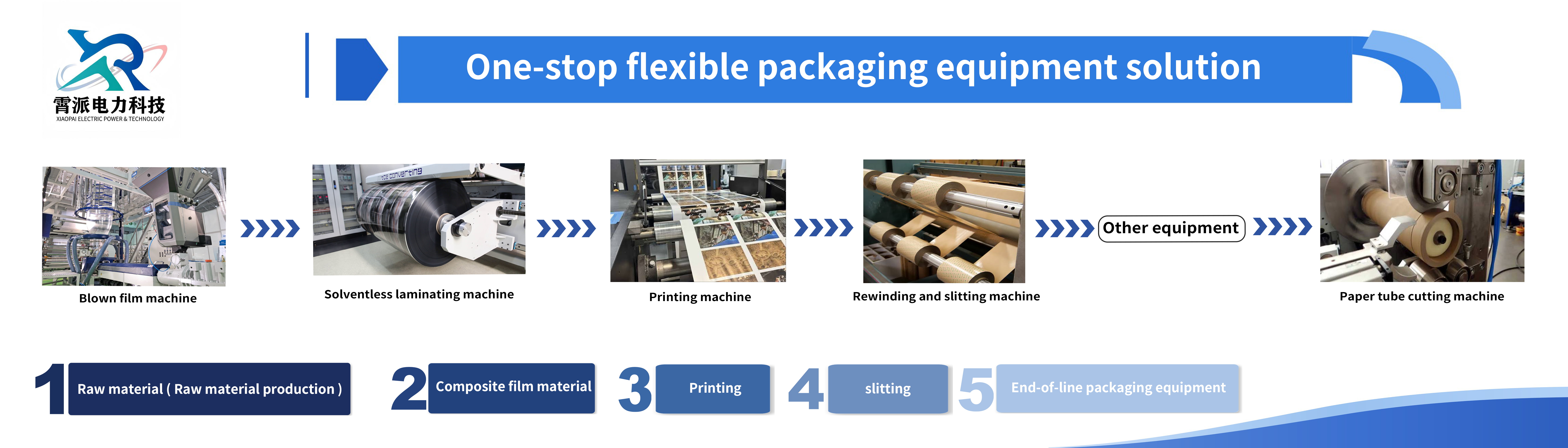
XIAOPAI - Wenzhou Xiaopai Electric Power Technology Co., Ltd. - works with long-established Chinese manufacturers to supply the flexible packaging line, from film blowing through laminating, printing and slitting. The blown film machine is where that line starts: it turns resin pellets into the film every stage after it converts. It is also the machine with the longest distance between "delivered" and "running". A blown film line arrives as a set of pieces - extruder, die head, air ring, haul-off, winder - and becomes a production unit only after the site is ready, the parts are aligned and the bubble has been tuned to the resin it will run. This note covers that path to the first saleable roll, and what a commissioning record should show at the end of it.
1. THE SITE IS PART OF THE SPECIFICATION
A blown film line is quoted in an office and paid for in a factory, but it is really built twice: once in the works, and once on the buyer's floor plan. The second build is the one nobody invoices, and it is where delivery schedules are quietly lost. Before the crates leave, someone on the receiving side should have walked the route with a tape measure, because a machine does not negotiate. The ABC65/75/65-1800 line, for example, stands roughly 13,000 by 5,200 mm on the floor and reaches 11,000 mm into the air - numbers that decide door heights, crane reach, the turning circle of the forklift and the clearance under the roof trusses long before they decide anything on the drawing board. The floor itself belongs in the survey too. A blown film line is a chain of separate units - the extruders, the die head, the haul-off and the winder - and each one carries its own load. Where the subsoil is soft or the slab is thin, the answer is a proper foundation pad under the heavy stations, planned before delivery, not discovered when the level reads wrong after installation. It is also worth writing down, before the crates arrive, where each unit will stand: the sequence of the line can be shifted a little on paper, and hardly at all in steel.2. THE CONNECTIONS THAT MUST BE FINISHED BEFORE THE CRATES
A commissioning week starts on the day the last utility reaches the machine, not the day the truck reaches the gate. Four connections decide that day: power, compressed air, cooling, and somewhere for the heat to go. Each has a habit of being ninety percent finished when the installation team arrives - which, for a production line, counts as not finished. Power is the one to start earliest, because the supply has to match the order record: the voltage and frequency confirmed at the contract stage are what the control cabinet was built for, and a mismatch is not a site adjustment, it is a rebuild. The feed should reach the machine position with the isolation point already installed and labelled. Compressed air has two requirements that the line takes literally: pressure, and dryness - a film line that breathes wet air is a film line that will eventually argue about it through a valve or a sensor. Cooling and heat removal are the two halves of the same thermal budget: whatever the process puts into the air and water has to leave the hall in an orderly way, or the hall temperature climbs and takes the bubble stability down with it. None of this is exotic. All of it is boring to arrange and expensive to improvise, which is exactly why it belongs at the top of the punch list.3. ASSEMBLY IS AN ALIGNMENT JOB
The mechanical installation of a blown film line looks like heavy work and is actually precision work. Bolting the extruders down is a morning; making the whole line agree on one centreline is the week. From the die head outward, every element the bubble touches - the air ring, the haul-off nip, the collapsing frame, the winder axis - has to sit on the same vertical line and the same height reference, so the bubble rises straight, collapses symmetrically and winds without a fight. This is where experience on the installation team shows. A line assembled roughly will still run; it will simply run with a lean, a bubble that prefers one side, and a winder that produces a roll with hard edges that show up again at printing. The measurements themselves are ordinary - level, centreline, perpendicularity - and the discipline is to check them twice and record them once, in the commissioning file rather than in someone's memory. Alignment also has a deadline built in. The window to move a heavy station is before the services are connected and the cable trays are dressed. After that, every millimetre costs ten times more than it should.
4. THE ELECTRICAL CHECK BEFORE THE FIRST HEAT
Barrel heaters are the first part of the machine that can damage themselves, and the easiest moment to protect them is while everything is still cold. The electrical check that precedes first heat is a zone-by-zone walk: each heating zone and its thermocouple verified against the drawing, the rotation of the screw confirmed in jog mode before any material is anywhere near it, the earth and insulation readings taken and filed. The safety chain gets the same treatment before the first start rather than after the first incident: interlocks on the guards, the emergency stop tested from every station along the line, and the winder's safety logic proven at crawl speed. On a machine where several units are wired together, the habit that pays is simple - one checklist, ticked unit by unit, with the line cold and quiet. Every fault found in that state costs minutes. The same fault found at production temperature costs a day and a barrel of spoiled resin.5. COMMISSIONING THE BUBBLE
The bubble is where the equipment becomes a process, and the commissioning sequence follows the physics: heat, then melt, then bubble, then speed - never the other way round. The zones come up to temperature and stay there long enough to be believable; the screw starts turning and the melt reaches the die; the bubble is drawn up at low speed and low output, and only once it is rising straight and collapsing cleanly does the line begin to earn its rating. Two of the line's features exist almost entirely for this phase. Internal bubble cooling, IBC, is what lets the bubble carry more output without turning tall and unstable - but it rewards a line whose cooling air is clean and whose operator has been shown what stable looks like. And the take-up speed is a ceiling before it is a setting: the published figure of 100 to 120 m/min on the ABC65/75/65-1800 assumes a trained hand on the haul-off and a converged structure. The way to arrive there is in steps, logging the gauge at every step, because the prints worth keeping from a commissioning week are the ones showing where the film moved out of tolerance, not the ones showing the fastest number the line ever saw.6. THE FIRST ROLL: WHAT ACCEPTANCE MEASURES
Acceptance is a set of numbers, not a feeling, and on this class of line the numbers are published before anyone plugs it in: film from 0.013 mm to 0.20 mm, a folding diameter up to 1,600 mm, output of 200 to 300 kg/h depending on structure, rolls up to a diameter of 1,000 mm, and, running LDPE at 0.15 to 0.20 mm, a thickness deviation held within plus or minus four percent. Those are the targets; the acceptance day is the instrument that checks them, one by one, on the buyer's floor and the buyer's resin. There is a sequence worth keeping in the record: gauge first, because thickness decides print registration and lamination strength downstream; then the wind, because a roll that passes gauge and fails wind quality ships its problem to the next machine instead of solving it; then output, run at the contracted point rather than at the fastest hour of the afternoon; and finally the eye test on the film itself - gels, streaks, and the general look of a film that has been stretched evenly. A new line entering production is an event the wider industry follows - the launch of a new extrusion line is exactly the kind of news that gets written down - but the real milestone is domestic and unphotogenic: the first roll that clears every one of those numbers at the same time.7. TRAINING, DOCUMENTS AND THE HANDOVER
A production line is handed over twice: once as an asset on the acceptance list, and once as knowledge in the crew that will run it. The second handover decides the first year of the machine's life. The training that matters is not a tour of the control panel; it is the short list of situations the crew will actually face at two in the morning: a start-up that will not hold a bubble, a structure change with its own temperature profile, a gauge drift that the automatic control is only half compensating, and the safety habit of stopping a machine that is behaving strangely rather than watching it. The industry's own reading of the problem - including its workforce development work - keeps arriving at the same conclusion: trained operators are the scarcest component of a converting plant, and no commissioning schedule changes that after delivery day. The documents close the loop: the manual as written for the supplied configuration, the electrical drawings as built, the spare-parts list matched to the machine's own bill of materials, and the commissioning record with its measured numbers. When those four things sit with the crew and not in an email thread, the handover is real. XIAOPAI operates two equipment modules - flexible packaging and power transmission - and supplies the blown film machine as part of the flexible packaging line, through the manufacturers it works with rather than a factory of its own. What XIAOPAI brings to a delivery is the layer around the equipment: export handling, installation supervision, operator training and after-sales support, with the machine covered on the blown film extrusion machine page. The film from the first roll is also the interface to the rest of the line: the slitter, the laminator, and for most structures the first stop of all, the press - the stage covered on our CI flexo printing machine page. On the laminating side, the range is anchored by the SINSTAR-built WRJ i9-1300A solventless machine, supplied under the authorized global distributor arrangement between SINSTAR and XIAOPAI. Commissioning a blown film machine is commissioning the front of a line; the handover is only complete when the rest of the chain knows what the first roll will do.ONE LINEXIAOPAI - Wenzhou Xiaopai Electric Power Technology Co., Ltd. manufactures the power transmission equipment line in Wenzhou, Zhejiang, and works with long-established Chinese manufacturers for the flexible-packaging line, supplying the blown film machine range above. Relevant pages:
blown film extrusion machine ·
CI flexo printing machine.


