


A flexible packaging equipment supplier for complete production lines China can send an equipment list within a day of the first email. Lists are easy to compare and easy to get wrong, because a line is not the sum of its machines. On a compact line the envelope comes from the laminator. One machine fixes four numbers before anything else is chosen: 850 mm of web, 300 m/min, 42 kW, and a footprint of 2,000 by 2,450 mm.
Take those four numbers one at a time. Each one sets a limit that the press, the slitter, the pouch maker and the building have to respect, and each limit can be checked before the order rather than after installation.
THE LINE IS AN ENVELOPE, NOT A LIST
An envelope has four walls: width, speed, power and floor. Every station has to fit inside them, and the smallest value in each direction wins. A buyer who compares lists compares catalogues. A buyer who compares envelopes compares what the line will run on a Tuesday afternoon in month three.
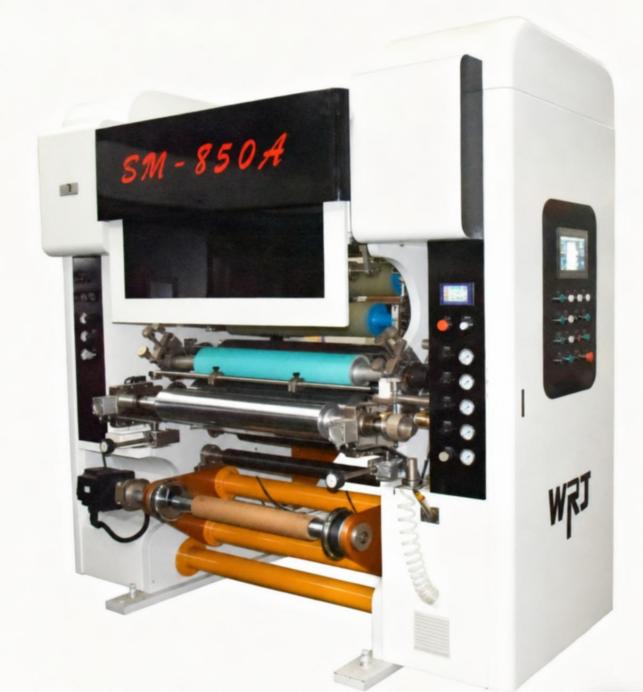
The four numbers below come from one machine, the SM-850A, a compact solventless laminator with five-roller coating. They are not the only figures on the line, but they are the ones that decide the others.
WIDTH: 850 MM IS THE CEILING
The 850 mm maximum feeding width is the widest material the laminator accepts. It is also the widest finished roll the line can sell without slitting, so nothing upstream needs to be wider.
A press rated at 1,300 mm can still feed this line. It will run with 450 mm of every web trimmed away, and that trim is paid for twice, once in film and once in waste handling. The same rule runs downstream, where a slitter wider than 850 mm adds floor space and nothing else.
Where the laminator is a compact solventless laminating machine, the sensible buy is a press and a slitter at 850 mm, with the saving spent on tension control instead. A wider laminator, such as the BD-1300A at 1,250 mm, moves the whole envelope and belongs to a different line plan.
SPEED: 300 M/MIN AT THE LAMINATOR
300 m/min is the laminator's own ceiling. The line rarely reaches it, because output is set by the slowest station, and that station is usually the pouch maker, the slitter or the rewinder.
Measure the line at its end rather than at the laminator's panel. A line that prints, laminates and slits at 300, 300 and 180 m/min is a 180 m/min line with two expensive machines standing in front of the bottleneck.
Two stations decide whether the line holds its speed. The unwind has to splice without stopping, which is the argument behind automatic unwind butt splicers on printing presses. The printing station upstream has its own drying curve, and drying and curing set a rate that no laminator can hurry.
MATERIALS: SEVEN THICKNESS WINDOWS
The SM-850A is specified for seven substrates. BOPP runs 18 to 50 µm, PET and VMPET 12 to 30 µm, VMCPP 20 to 60 µm. LLDPE covers 30 to 100 µm, glassine 28 to 60 gsm and nylon 15 to 100 µm. Most of them arrive as rolls from a blown film extrusion machine or a cast line, and the roll quality decides how the laminator behaves before the first metre runs.
Nylon at 15 µm and LLDPE at 100 µm pull very differently. The line has to cover both, which is why the unwind runs 3 to 30 kg over the full width and the rewind runs 4 to 40 kg with taper from 0 to 100 percent. A machine set for one end of that range will mark the other.
Web handling is where the cost sits when a line is pushed, as the battery industry found when web handling costs moved to the centre of the process.
POWER: 42 KW, NINE OF THEM HEAT
Total connected power is 42 kW, and 9 kW of that is heating. The heating load explains the start of the shift: the coating and laminating rollers have to reach temperature before the first splice, so the machine warms up before it runs.
The supply is 380 V at 50 Hz. A site on 440 V or 60 Hz needs a transformer or a different motor set, and that decision belongs in the layout rather than in the commissioning week. Heating is also the first place to look when energy per metre is reviewed, which is the case made for electrothermal drying systems.
FLOOR: 2,000 BY 2,450 MM, 4,300 KG
The machine measures 2,000 mm long, 2,450 mm wide and 2,480 mm high, and weighs about 4,300 kg. Those figures describe the machine alone.
The line adds what the machine needs around it: space to load and remove rolls, an operator aisle, and a route from the roll store to the unwind. A compact machine can still need a wide door, a level floor and a forklift that reaches the shaft height.
Check the height as carefully as the length. A 2,480 mm machine under a 2,400 mm beam is a machine that arrives and does not go in.
WHO DELIVERS WHAT
A supplier of complete lines delivers more than the machine. The scope covers the five-roller coating unit, the Siemens S7-1200 control, the 10 inch screen and the SMI-40 automatic adhesive mixer, which talks to the main machine. The documents travel with the shipment.
The buyer delivers the site. That means 380 V at 50 Hz, compressed air at 0.7 MPa, water at 2 to 4 kg/cm², the floor, and a transformer if the local supply does not match. Put both lists in one table and sign it, because the gap between them is where commissioning weeks disappear.
A flexible packaging equipment supplier for complete production lines China is worth judging on that table rather than on the machine photograph.
HOW TO COMPARE TWO OFFERS
Two offers can look identical in a meeting and differ by a factor on the floor. Compare eight rows, all numeric. The first four are web width, line speed measured at the end, substrate list with thickness windows, and unwind and rewind tension ranges. The last four are connected load, air and water demand, footprint with clearances, and the name of the person who signs the acceptance test.
Two rows catch most of the difference. A slitting machine rated above the laminator changes nothing, while one rated below it becomes the line. A footprint quoted without clearances fits on paper and not in the building.
Ask for tension and temperature logs from a reference line. Web handling data is still mostly manual, and a supplier who can produce a month of it is telling you something about the installation.
Four numbers decide most of a complete line: 850 mm, 300 m/min, 42 kW and 2,000 by 2,450 mm. Put them on one page with the substrate list and the utility demand, and the equipment list stops being a negotiation and becomes a checklist.


