


Most film machines make a flat sheet. A blown film machine makes a tube instead: melted resin goes through a circular die, air inflates the middle, and the bubble rises, cools and is flattened into a roll at the top.
That shape is easy to overlook and hard to overstate. The tube is why a plastic bag needs one seal instead of three. It is also why the die sets the width of everything downstream, and why this machine looks like a tower rather than a press.
WHAT THE MACHINE ACTUALLY DOES
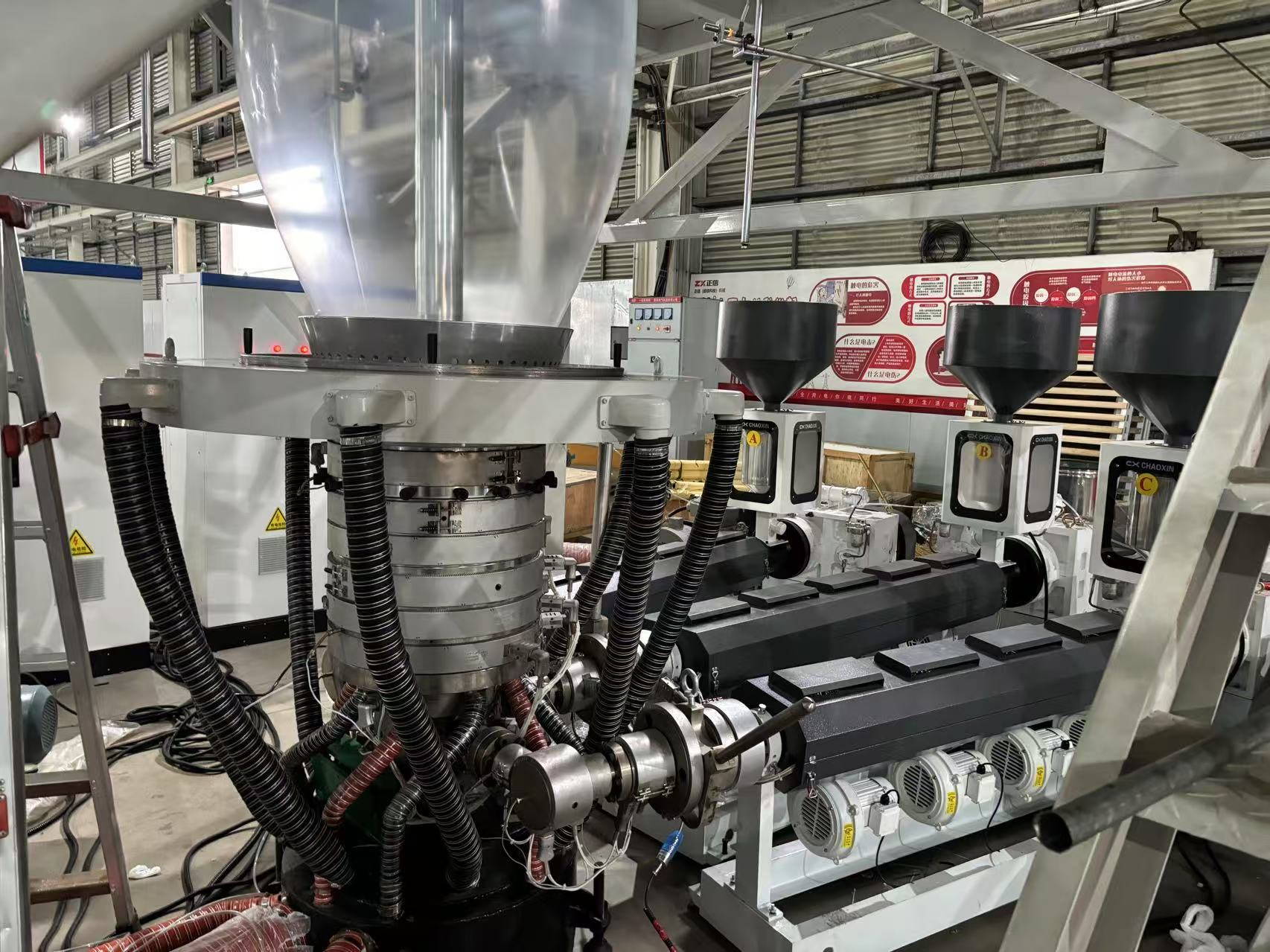
Three extruders melt three resins and push them into one die. The die is a ring, so the plastic leaves as a wall of molten tube. Air blown into the centre inflates that tube to the size the job needs, and the air ring outside cools it until the film holds its shape.
At the top, a pair of rollers pinches the tube flat and pulls it upward at 100 to 120 m/min. The flattened tube is wound into a roll. From pellet to roll, the material never stops moving, and the shape never stops being a tube until the nip closes it.
WHY THE TUBE IS THE POINT
Take a linersack and look at its edges. Two sides are folds, not seams. The only seal is across the bottom, and that works because the film arrived as a tube: the bag maker cuts it to length, seals one end, and the sides are already closed.
A flat sheet cannot do that without two extra seals and two extra chances to leak. For a refuse bag, a courier bag or a linersack, the fold also survives handling better than a seam, because the film bends there rather than ends there. Most bags of this kind are made from PE film, which is what makes the fold reliable.
This is the quiet advantage of the process. The machine is not making film and then shaping it. It is making the shape and the film at the same time.
WHAT SETS THE SIZE OF THE TUBE
Two things set it: the die diameter and the air inside. More air makes a bigger bubble, less air makes a smaller one. The limit is the folding diameter the tower and the collapsing frame can handle, which on this line is 1,600 mm.
Folding diameter is not film width. A 1,600 mm bubble collapses into roughly 2.5 m of layflat, and that is the width the winder sees and the bag maker receives. Thickness runs from 0.013 to 0.20 mm, and those two figures decide how fast the line runs for a given output.
This is where most buying mistakes start. A converter asks for 1,600 mm of film, receives a 1,600 mm folding diameter, and finds the roll is nearly a metre wider than expected. Ask which number the supplier means, and ask for the layflat beside it. On-line gauging is how the thickness side of that conversation gets settled with data rather than with a sample.
WHY BLOW A BUBBLE INSTEAD OF CAST A SHEET
Cast film is squeezed through a flat die onto a chilled roller. It is flatter, clearer and faster, and for some jobs it is the right answer. Blown film takes a different route: the bubble stretches the film in two directions at once, along the tower and around the circumference.
That two-way stretch is why blown film dominates bags and liners. The film ends up with strength in both directions rather than mostly along the machine direction. The trade is flatness and optics, which is why a printer who needs fine register still prefers cast or a well-controlled blown web.
So the tube is not a compromise. It is the reason the film behaves the way it does, and the reason the machine has a tower.
WHAT THE TUBE COSTS YOU
A tube has to be collapsed before it can be wound. That happens in the collapsing frame, where the bubble is guided into a flat web by two angled boards and a set of rollers. Set that frame badly and the film folds with a crease that stays in the roll.
The tube also turns every gauge variation into a pattern. A thick lane at one point on the die becomes a band that runs the length of the roll. The rotating haul-off spreads it, but it does not remove it, which is why the die and the air ring still decide quality.
Winding the collapsed tube brings another problem. A charged web drags on rollers and pulls dust with it, and the roll reaches the printer dirty, which is the argument for static control at the winder rather than at the press.
And the tube has edges where it folds. Those folds are not cut off, they become the edges of the bag. A die that runs thin at the lip shows up as a curled edge in the finished product, not as a number on a report.
THREE LAYERS, ONE TUBE
The three extruders on this line run 65, 75 and 65 mm screws and feed one die, so the tube is built from three layers at once. The inner layer carries the seal, the middle carries stiffness or barrier and usually the regrind, and the outer carries print and slip.
That is why the middle screw is the largest. It feeds the layer that carries most of the thickness. A monolayer line can do the same job only by compromising one property for another.
WHAT HAPPENS WHEN THE TUBE IS OPENED
Not every roll stays a tube. A converter who needs sheet sends it through a slitting machine, which trims the folds and opens the web into a flat sheet. The film keeps its two-way stretch, but the folded edge is gone.
Most rolls go the other way. They are printed on a CI flexo press, laminated on a solventless laminator, or converted straight into bags. Printing needs a surface the ink will hold, which is why a corona treater sits before the winder.
A barrier job adds one more step. Metallized PE is built on a flat, even base web, because every wrinkle in the base shows up as a shadow in the metal layer.
Whichever route it takes, the tube shape is still in the film's memory. Flatness, edge curl and the position of a gauge band all come from the bubble, and all of them travel downstream.
HOW TO SPECIFY ONE WITHOUT GUESSING
Six questions cover most of it. What layflat width do you need, and what folding diameter does that imply? What thickness, and at what tolerance? Which resins and which layer split? What take-off speed and what output at your gauge? Is IBC internal cooling fitted? What does the film become next, print, laminate or bag?
The answers decide the die, the air ring, the tower and the winder, in that order. A supplier who quotes a machine before those six are settled is quoting a catalogue number rather than a line.
Tolerance belongs with them. The ±4 % on this line applies to LDPE between 0.15 and 0.20 mm. The measuring method and sampling position should be named beside it, which is how the blown film machine page states its figures.
WHO BUILDS IT, WHO SUPPLIES IT
SINSTAR manufactures the ABC65/75/65-1800 three-layer line. XIAOPAI supplies it as authorised worldwide distributor and handles the specification, the pre-installation document and the commissioning coordination.
The next time you look at a plastic bag, look at its sides. If they are folds rather than seals, the film began as a tube on a blown film machine, and the machine did its job before the bag maker touched it.


