


One-Stop-Flexible-Packaging-Solutions
Wenzhou Xiaopai Electric Power Technology Co., Ltd. (XIAOPAI) supplies complete
flexible packaging lines and the materials that run on them: one contract, one specification and one technical contact, from layout drawing to warranty.
XIAOPAI is an authorized global distributor of SINSTAR flexible packaging machinery, which gives buyers three practical benefits: a proven, series-produced design rather than a one-off build; a technical file and spare-parts channel open for the life of the machine; and a line configured, installed and supported by engineers who work on these machines daily.
What we supply
Scope | Content |
Equipment | Blown film extrusion CI flexo printing Hot knife laminating Solventless laminating Slitting and rewinding Paper tube cutting 11 models in 6 categories |
Materials | Laminated finished film in common food-contact structures; blown-film grade resin for the extrusion line |
Engineering | Line layout and utility schedule, machine configuration to the target product, installation supervision, commissioning, operator training |
Support | English documentation, spare and wearing parts, remote diagnosis, on-site engineer dispatch |
Two businesses, one delivery method
XIAOPAI began in power equipment: distribution transformers, vacuum circuit breakers, switchgear and compact substations up to 230 kV and 200 MVA, shipped to more than forty countries. Flexible packaging is a second business built on the same export operation and customers: a manufacturer who buys electrical equipment for a new plant often asks months later who can equip the packaging hall next door.
What carried over is how we deliver: one contract, one specification, one technical contact and a schedule that holds. A buyer sourcing six machines from five suppliers spends the project managing the gaps between them. With XIAOPAI, we manage those gaps.
Who we work with
l A converter building a first line — one laminator and one slitter, laid out so two more stages can be added without relocating them.
l A plant replacing one stage — one machine matched to the web width, speed and core size of the existing line.
l A trader or integrator — a documented English package to hand to their own client.
A line is only as complete as the qualified sources behind each stage ofit.
XIAOPAI does not build every component in-house. Instead the company keeps an audited pool of specialist manufacturers — three to five qualified builders per equipment category. A line is assembled from that pool around the buyer's product, and XIAOPAI carries the interface: configuration, inspection, installation, commissioning, training and spares afterwards.
How a builder enters the pool
Screening criterion | What is checked | Why it decides whether we sell the machine |
Export record | Machines already running outside China, and for how long | A design that has not been shipped has not been proven in service |
Parts commonality | Whether bearings, drives, seals and heaters are standard catalogue items | A proprietary part is a stoppage the buyer cannot fix locally |
Technical file completeness | Drawings, parameter tables and manuals available in English | The line has to be maintainable without us on site |
After-sales response | Measured response time on spares and remote diagnosis | This is what the warranty actually consists of |
Build standard | Frame stiffness, guarding, electrical practice, paint and finish | Decides whether the machine still runs true after five years |
Why the pool matters to the buyer
What a single-supplier line cannot do | What an audited pool does |
Every machine follows one house style; if that builder has no machine for a stage, the stage is missing | Each stage comes from the builder who specialises in it, so the line is complete rather than compromised |
A model change or a discontinued series leaves the buyer without spares | More than one qualified source per category, and parts commonality is a screening criterion |
Technical files arrive in different formats and languages | One English documentation set, one parameter convention, one spare-parts list |
The buyer integrates the stages and carries every interface risk | XIAOPAI integrates the stages; the buyer holds one contract and one performance point |
Most packaging projects fail not on the machine but on the interfaces between machines, or between the approved sample and the delivered roll.
This is the sequence we follow on every line, whether it is one laminator or a six-stage plant. Each step ends in a document the buyer approves, so a problem appears at the step that caused it.
How we work
l Line first, machine second. Start from the finished pack and work back to the machine.
l No hidden scope. Every scope sheet states what is included and what the buyer prepares.
l Documentation in English. Manuals, drawings and parameter tables, so the line runs without a translator.
The six steps
Step | What happens | Document the buyer receives |
1 Pack definition | Substrate, structure, print design, fill weight and output per shift are fixed and costed | Written pack specification and line duty point |
2 Line configuration | Each stage is sized against the duty point; models are selected and the utility load is calculated | Line layout drawing, utility schedule, machine list |
3 Pre-shipment inspection | Every machine is assembled and run on the builder's floor; gauge, register, tension and speed are measured | Inspection report with measured values |
4 Installation and commissioning | Foundation, levelling, utilities, alignment between stages, first production run | Commissioning report and signed performance figures |
5 Training | Operators and maintenance staff are trained on the actual line, not on a generic machine | Training record and English operation manual |
6 After-sales | Spare parts, wearing parts, remote diagnosis and engineer dispatch | Spare-parts list with lead times |
A line is specified only after the duty point in step 1 is agreed; specifying machines first is how buyers get equipment that runs well, but not on their product.
A flexible packaging plant is a chain, not a collection of machines. Film leaves the extruder,
takes its print in the flexo press, receives its barrier layer in the laminator, and is finally slit to the width the bag maker needs. The line is only as good as the weakest handover between those steps: web tension, web width, roll hardness and roll diameter all have to agree.
XIAOPAI supplies every step of that chain, which is why the models in this document are grouped by process rather than listed as a catalogue. Matching the slitter to the laminator, or the blown film die to the printer's web width, is a decision we make with you before an order exists.
Step | Process | Category | Models in this document |
1 | Film extrusion | Blown film | ABC-1800 |
2 | Surface printing | CI flexo | Master Series FFS · YTE81000 · YTE61000 |
3 | Laminating | Hot knife & solventless | XPM-1080RN · XPM- 1100J · WRJ Fi9 · WRJ i9 · S 1 |
4 | Slitting & rewinding | Slitter rewinder | CLFQ-W 1100 · 1300 Type |
5 | Core making | Paper tube cutting | Q5-1200 |
Component brands, electrical schedules and commercial terms are left out of this document and supplied in the order-specific technical file.
Which line makes which pack
Pack format | Line | Governing constraint |
FFS heavy-duty sack | ABC-1800 · FFS · XPM- 1100J · CLFQ | 700 mm print width; in- line gusset folding |
Stand-up pouch, roll stock | ABC- 1800 · YTE61000 · WRJ i9 · CLFQ | Six colours at 1000 mm; repeat to 1000 mm |
Pharmaceutical sachet | ABC- 1800 · YTE81000 · WRJ Fi9 · CLFQ | Register ±0.08 mm; no solvent residue |
Folding carton and board | XPM-1080RN | 1080 × 1500 mm sheet; hot knife above 127 gsm |
Paper cores, in-plant | Q5-1200 | 0.01 mm length; 0.5 s per cut |
Where a pack falls outside this table, the line is still configured from the pack backwards. The constraint is the finished product, not the machine list.
Extrusion sets the limit for every step downstream: film that leaves the die with uneven thickness cannot be printed in register or laminated flat. The three-layer IBC line below controls this at the source — bubble cooling fixes the frost line, three extruders place the additives in the skin while the core carries strength, and the take-off is servo-synchronised.
ABC-1800 Three-Layer Co-Extrusion IBC Blown Film Line
Three extruders with internal bubble cooling, for LDPE, LLDPE, MLLDPE and HDPEfilm at 100–120 m/min.
Key advantages
l Internal bubble cooling — cooling air circulates inside the bubble as well as outside it, which raises output for a given die diameter and holds the frost line stable at speed.
l Independent layer dosing — additives sit in the skin, where they are needed, instead of being spread through the whole wall.
l Gauge held across the web — on LDPE at 0.15–0.20 mm, thickness deviation stays within ±4%, the figure that decides downstream register.
l One line, four resins — no die change between bag grades.
Technical parameters
Take-up speed / maximum output | 100–120 m/min; 200–300 kg/h |
Maximum folding diameter | 1600 mm |
Thickness / deviation | 0.013–0.20 mm; LDPE 0.15–0.20 mm within ±4% |
Maximum winding diameter | φ 1000 mm |
Suitable materials | LDPE / LLDPE / MLLDPE / HDPE |
Overall dimensions | 13000 × 5200 × 11000 mm |
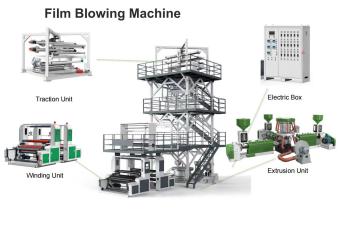
ABC-1800 — extruder, 11 m bubble tower, traction and winding
All three presses share one platform. A central impression (CI) drum carries the web
through every colour without releasing it, gearless electronic shafts replace the gear train, and plate and anilox cylinders are sleeve type. Because the web stays on the drum between colours, register holds while the press speeds up or slows down — the defining property of a CI press.
Shared by all models: closed-chamber doctor blade, non-stop flying-splice unwind and rewind, closed-loop tension with taper control, automatic edge guide before the first unit, and PLC print inspection on the running web.
The models differ in the job they are built for: heavy-duty FFS sack film with in-line embossing and folding, high colour count at 1000 mm width, or a mid-width workhorse. Choose on print width, colour count and whether you need embossing.
The three models at a glance
Model | Colours | Print width | Production speed | Built for |
Master Series FFS | 4 | 700 mm | 150 m/min | Heavy-duty FFS sack film; in-line embossing and folding |
YTE81000 | 8 | 960 mm | 350–450 m/min | High colour count; the tightest register in the range |
YTE61000 | 6 | 960 mm | up to 400 m/min | General flexible packaging; the longest repeat |
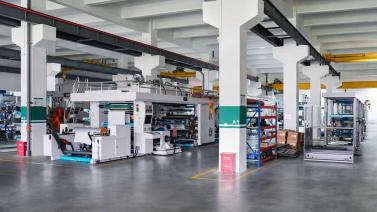
CIflexo press in production — non-stop unwind, in-line corona and video web inspection
Master Series FFS Heavy-Duty Full Servo Sleeve CI Flexo Press
Four colours at 800 mm with in-line embossing and folding — a press built for heavy-duty FFS sack film, where printing, embossing and gussetfolding happen in one pass.
Key advantages
l Three processes, one pass — printing, embossing and folding run from the same servo line, so the sack leaves the press already printed and folded.
l Register that holds at speed — ±0.1 mm, and it stays within that band while the press speeds up or slows down, where gear-driven presses lose register.
l Fast changeover — a full set of plate and ceramic rollers is exchanged in about three minutes, so short FFS runs stay profitable.
l Sized for sack film — web path, tension range and folding unit are built for 700 mm heavy-duty film rather than adapted from a general-purpose press.
Technical parameters
Maximum feeding width | 800 mm |
Maximum printing width | 700 mm |
Colours | 4 |
Printing length (repeat) | 360–900 mm |
Maximum printing speed | 150 m/min (varies with substrate, ink and design) |
Registration precision | ±0.1 mm |
Plate thickness | 1.7 / 2.28 / 2.84 mm (custom on request); tape 0.38 mm |
Embossing depth / folding depth | 0.2–0.5 mm / 0–100 mm |
Maximum roll diameter | φ 1500 mm, 6 ″ air shaft |
Web tension range | 5–20 kg per full width |
Power / weight | 100 kW / 25 000 kg |
Overall dimensions | 15.2 × 3.5 × 4 m |
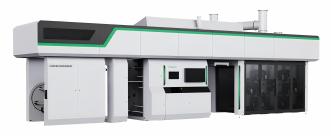
Master Series CIflexopress — unwind,four colour decks around the CI drum, in-line embossing and folder
Master Series YTE81000 8-Colour Gearless Sleeve CI Flexo Press
Eight colours at 1000 mm with a 500 m/min mechanical speed — the model for high-colour- count work where register tolerance decides whether the job can be sold.
Key advantages
l ±0.08 mm registration — the tightest figure in the range, and the reason this press suits photographic designs and fine reverse type.
l Eight colours at 1000 mm — enough stations for extended-gamut work, spot colours and a coating without a second pass.
l Wide substrate range — paper below 65 gsm, PE, PET, BOPP and PVC run on the same press, so a converter is not tied to one film type.
l 350–450 m/min in production — the working speed, not only the mechanical ceiling, and this is what sets output per shift.
Technical parameters
Model | Master Series YTE81000 |
Maximum material / printing width | 1000 mm / 960 mm |
Colours | 8 |
Mechanical / printing speed | 500 m/min / 350–450 m/min |
Printing length (repeat) | 360–960 mm |
Substrates | Paper below 65 gsm, PE, PET, BOPP, PVC |
Printing cylinder / anilox | Sleeve type / sleeve type ceramic |
Maximum unwind & rewind diameter | φ 800 mm; tape 0.38 mm |
Registration precision | ±0.08 mm |
Drying | Hot air, 4.5 m tunnel, max 80 °C, air speed 5–30 m/s |
Ink / power supply | Water or solvent based; 380 V, 3 phase, 50/60 Hz |
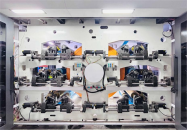
Gearless sleeve plate cylinders, closed-chamber doctor blades and the enclosed webpath between decks
Master Series YTE61000 6-Colour Full Servo Gearless Sleeve CI Flexo
Press
Six colours at 1000 mm, fully servo driven — the balanced specification for general flexible packaging, where six stations cover mostfood and daily-chemical designs.
Key advantages
l Six colours, 1000 mm width — covers the large majority of food, detergent and personal-care designs without paying for stations that stay idle.
l Print repeat to 1000 mm — the longest repeat in the range, which matters for large pack formats and for shrink-sleeve work.
l Flying-lap splicing — automatic on both unwind and rewind, on rolls to φ600 mm with 3 ″, 4 ″ or 6 ″ cores.
l Wide tension window — 20–300 N under servo control with floating roller and encoder feedback, from 12 µm film to heavy paper.
Technical parameters
Model | Master Series YTE61000 |
Colours | 6 |
Maximum material / printing width | 1000 mm / 960 mm |
Printing length (repeat) | 370–1000 mm |
Printing speed | Up to 400 m/min (ink, plate, design and substrate dependent) |
Mechanical speed | Up to 500 m/min |
Unwind / rewind | Non-stop, flying-lap splice, reel φ600 mm, core 3 ″/4″/6″ |
Web tension range | 20–300 N, servo control with floating roller and encoder |
Web guide | Edge guide before printing and before rewind, ultrasonic scanning head |
Drying | Electric heating, fully enclosed, variable air volume |
Transverse adjustment | ± 10 mm, electric |
YTE61000 or YTE81000
Choose the YTE61000 when four to six colours cover the design, ±0.1 mm register is accepted and 400 m/min meets the shift target. Choose the YTE81000 when seven or eight colours are needed, when ±0.08 mm is written into the print approval, or when the volume calls for 350–450 m/min in production.
Hot knife lamination bonds a printed sheet or web to a film using a hot-melt adhesive that is
applied, dried and activated on the machine, then cut with a heated blade. The heated knife is the distinguishing part: it seals the cut edge as it separates the sheet, so the laminate does not delaminate at the trim and the stacker receives clean, square piles.
Two formats cover the market. Sheet-fed machines take pre-cut printed sheets and deliver a finished stack — cartons, book covers, display work. Roll-to-roll machines run a printed web against a film web and rewind — packaging film and label stock. Both XPM models apply the adhesive without solvent and both use non-stick coated drying rolls, so the adhesive releases cleanly at temperature.
The two models at a glance
Model | Format | Maximum size | Working speed | Built for |
XPM-1080RN | Sheet-fed | 1080 × 1500 mm | 70–100 m/min | Cartons, book covers and display board |
XPM-1100J | Roll-to-roll | 1050 mm web, 30–500 gsm | 80–100 m/min | Packaging film and label stock |
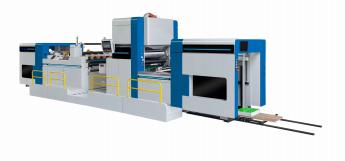
Hot knife laminator — automatic sheetfeeder, hot knife coating unit and stacker
Sheet-fed or roll-to-roll
Question | Sheet-fed XPM-1080RN | Roll-to-roll XPM-1100J |
What arrives at the machine | Printed sheets, already cut to size | Printed roll plus a laminating film roll |
What leaves the machine | A finished, squared stack | A laminated roll for the next process |
Typical product | Cartons, book covers, display board, rigid box wrap | Packaging film, label stock, sachet laminate |
When to choose it | The next process runs sheets — die cutting, folding, gluing | The next process runs rolls — slitting, bag making, pouching |
XPM-1080RN Automatic Sheet-Fed Film Laminating Machine with Hot
Knife
Sheet-fed, 1080 × 1500 mm, with a double-servo hot knife and a fully automatic stacker — the model for high-volume sheet lamination where pile quality decides the next process.
Key advantages
l Throughput without an operator at the feeder — the sheet feeder runs to about 15 000 sheets per hour with non-stop pre-stacking, so the machine does not idle while a pile is reloaded.
l Overlap held to ±2 mm — the overlap is set by servo rather than by a mechanical cam, which is what keeps the pile square at high speed.
l Either cutting method, one machine — a disc cutter covers 80–500 gsm, and the hot knife takes over above 127 gsm where a cold cut would delaminate.
l Heat that reaches the adhesive — an 800 mm drying roll with non-stick coating, electromagnetic plus oil heating, and a 25 mm machine wall that holds the roll temperature stable.
l Hot knife that keeps its edge — double servo positioning with a blade heat-treated to 600 °C, so the cutting geometry does not deform over a production run.
l Flat sheets into the stacker — an anti-curl device and corrugated delivery straighten thin stock before it is piled, with a 1060 mm stack height and side and front tidy plates.
l Operation — 10″ colour touchscreen on a PLC and fully pneumatic laminating pressure for a uniform nip load.
Technical parameters
Maximum sheet size | 1080 × 1500 mm (widths 1080 / 1280 / 1480 mm; lengths 1000–1700 mm) |
Minimum sheet size | 350 × 270 mm |
Paper thickness | Disc cutter 80–500 gsm; hot knife above 127 gsm |
Machine speed | 105 m/min |
Working speed | Disc cutter 80–100 m/min; hot knife 70–80 m/min |
Pile height (feeder / stacker) | 1160 / 1260 mm |
Machine power | 85 kW (working consumption 30–35 kWh) |
Overall dimensions | L 12 000 × W 3100 × H 3100 mm |
Machine weight | 11 500 kg |
Laminating substrates | PET, PVC, BOPP, CPP, metallised film, soft- touch film |
Disc cutter or hot knife is decided by stock and by the next process. Below 127 gsm the disc cutter is faster; above it, a cold cut leaves a delaminated edge that shows at the die cutter.
XPM-1100J Roll-to-Roll Laminating Machine with Coating Unit
Roll-to-roll at 1050 mm with a dedicated coating unit and shaftless unwinding — the model for packagingfilm and label stock, where the output is a rewound roll, not a sheet pile.
Key advantages
l Shaftless unwinding — accepts 3 ″ and 6 ″ cores and full jumbo rolls without a shaft, so loading is a single-operator task and roll changes are short.
l Adhesive goes further — the double metal-roll coating system with a rubber or metal blade handles a range of adhesives at 3–4 g/m², which is where the consumable cost of a laminating job actually sits.
l Non-stick drying roll — the 800 mm drying roll is coated so adhesive releases cleanly, and the coating also evens out the surface temperature compared with a plain chrome roll.
l Short web path — the compact threading route reduces the material lost at every start- up and job change.
l Two tensions, not one — an independent tension system for the film roll alongside the main web tension, so a light film is not pulled to the tension the laminate needs.
l Ultrasonic web guide — non-contact edge detection ahead of the coating nip, so the adhesive line stays inside tolerance on narrow lanes.
Because the output is a roll rather than a stack, the job is judged on roll quality as well as bond strength: a roll wound too soft will telescope on the shelf, and a splice in the middle of a lane stops the bag maker. The independent film tension and the short web path are what keep both figures under control, shift after shift.
Technical parameters
Model | XPM-1100J |
Maximum width | 1050 mm |
Working speed | 80–100 m/min |
Paper thickness | 30–500 gsm |
Unwinding diameter | φ 1400 mm (shaftless, 3 ″ / 6″ cores) |
Rewinding diameter | φ 1400 mm |
Total power | 120 kW |
Overall dimensions | 18 000 × 2800 × 3000 mm |
Machine weight | 14 000 kg |
Coating weight | 3–4 g/m² (double metal roll coating system) |
Equipment photo — insert here XPM-1100J roll-to-roll laminator |
Solventless lamination applies a two-component adhesive at 100% solids and cures it by chemical reaction instead of by evaporating a solvent. No drying oven, so the energy a dry laminator spends heating air is never spent; no solvent residue left in the laminate to migrate into the product, which is what makes the process acceptable for food, pharmaceutical and infant-nutrition packaging; and a shorter web path, so start-up waste and floor space both fall.
The three models cover the two decisions that matter: how many layers, and how much control. WRJ i9 is the two-layer machine for a stable high-volume structure; WRJ Fi9 adds width and multi-layer capability with full recipe management; S1 is the digital platform for plants running many short work orders, where changeover is a software event.
The three models at a glance
Model | Layers | Maximum width | Maximum speed | Built for |
WRJ Fi9 | Multi-layer | 1050 / 1350 / 1650 mm | 450 m/min | Wide web, multi-layer; full recipe management |
WRJ i9 | Two-layer | 1050 / 1350 / 1650 mm | 450 m/min | Stable high- volume two- layer work |
S1 | Two-layer | 1350 mm | 500 m/min | Many short work orders; digital changeover |
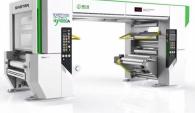
WRJ Fi9
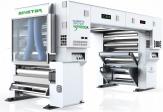
WRJi9
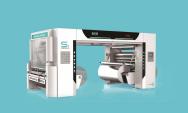
S1
Two questions separate the three models: how many layers the structure needs, and how often the plant changes work order. Width and speed are the same across the range.
Before the line is ordered: the curing room
Solventless adhesive cures by chemical reaction rather than by evaporation, so the finished roll still needs time and temperature to reach full bond strength: typically 24 hours for a common two-layer structure, longer where foil or a high-barrier layer is involved. Curing- room area and temperature control belong in the layout, not in the week after commissioning — a fast laminator with too little curing capacity still ships late.
WRJ Fi9 Solventless Laminating Machine
The high-performance model for snack bags, frozen-food film, pharmaceutical sachets and infant-nutrition bags: 1650 mm, 450 m/min,full recipe management.
Key advantages
l Five-roller coating system — mechanically precise metering across the full web width, so adhesive weight does not drift from the centre to the edge of a 1650 mm web.
l Adhesive weight measured, not assumed — closed-loop tension control combined with coating-weight measurement keeps the bond specification inside tolerance run after run.
l No drying system at all — no oven and no heating energy, which on a comparable duty typically removes around 60 000 kWh a year.
l Zero solvent residue — suitable for food, pharmaceutical and infant-nutrition structures without a residual-solvent test in the release criteria.
l Wide substrate range — BOPP, PET, PE, CPP, PA, aluminium foil and paper in the same machine, with recipe storage so a changeover is a recall, not a re-setup.
Technical parameters
Maximum laminating speed | 450 m/min |
Maximum laminating width | 1050 / 1350 / 1650 mm |
Maximum unwinding diameter | φ 800 mm |
Maximum rewinding diameter | φ 800 mm |
Material loading | Shaftless |
Core diameter | 3 ″ + 6 ″ |
Substrates | BOPP, PET, PE, CPP, PA, metallised film, aluminium foil, paper |
Structures routinely run on this machine
Structure | Layers | Typical pack | Why this machine |
PET / PE | 2 | Dry snack, general food pouch | The volume two- layer job; adhesive weight held across 1650 mm |
PET / Al / PE | 3 | Pharmaceutical sachet and strip | Foil-containing structures need zero solvent residue |
WRJ i9 Two-Layer Solventless Laminating Machine
The entry and volume model: two-layer lamination, 450 m/min, and a control system simple enough that a new operator is productive within two days.
Key advantages
l Deliberately simple — a reduced control system and a clear operating sequence mean less operator intervention per shift and far less training time. Two days takes a beginner to production.
l Multi-stage tension control — combined with a stable nip pressure system, so dissimilar materials still laminate flat and uniform without a trial run for every combination.
l Compact two-layer architecture — built specifically for two-layer structures rather than being a multi-layer machine run below its capability: smaller footprint, lower power, faster changeover.
l Wide material compatibility — BOPP, PET, PE, CPP, VMPET, VMCPP, nylon, aluminium foil and paper-based substrates on one machine.
l The same width and speed as the Fi9 — 450 m/min and up to 1650 mm, so the volume decision does not force a compromise on throughput.
Typical lamination structures
PET / PE · BOPP / CPP · BOPP / PE · PET / CPP · metallised film / plastic film · aluminium foil / plastic film · paper / plastic film.
Packaging uses
Food packaging film · daily consumer goods packaging · general-purpose laminated packaging materials.
Technical parameters
Lamination type | Two-layer solventless |
Maximum laminating speed | 450 m/min |
Maximum laminating width | 1050 / 1350 / 1650 mm |
Maximum unwinding diameter | φ 800 mm |
Maximum rewinding diameter | φ 800 mm |
Material loading | Shaftless |
Reel diameter | 3 ″ + 6 ″ |
Substrates | PET, BOPP, CPP, PE, PA, VMPET, VMCPP, aluminium foil, paper |
For three-layer and foil-containing structures, step up to the WRJ Fi9. The i9 is built for two- layer work; it is not a multi-layer machine sold below its capability.
S1 Digital Solventless Laminating Machine
500 m/min, 1350 mm, and a digital control layer that manages up to 300 work orders — built for plants whose constraint is changeover time, not running speed.
Key advantages
l 300 work orders in memory — temperature, pressure and speed are stored per job and recalled by number, so a changeover becomes a data entry, not an adjustment sequence.
l Three-roller back-pressure design — the coating nip is supported from behind, which keeps the adhesive film uniform and reliable across the web width.
l Tungsten-carbide coated rollers — roughly five times the wear resistance of a hard- chrome roll, so the service interval is longer and coating weight stays stable as the roll ages.
l One-click coating weight entry — the operator enters the target weight and the machine sets the metering, removing the manual trial-and-error pass at the start of each job.
l Adhesive proportioned automatically — the two components are dosed and mixed by the machine, so pot life and mix ratio are not left to the operator.
l Four-level proportional protection — a staged safety architecture covering mix ratio, pressure and drive conditions, so a fault stops the machine before it reaches the web.
l Adaptive tension and taper control — a swing-arm linkage with intelligent rewind taper, and both motors braking together so coating weight stays even during deceleration.
Technical parameters
Maximum laminating speed | 500 m/min |
Maximum laminating width | 1350 mm |
Maximum unwinding diameter | φ 800 mm |
Maximum rewinding diameter | φ 1000 mm |
Material loading | Shaftless |
Core diameter | 3 ″ + 6 ″ |
Work-order memory | Up to 300 sets |
What the digital platform changes in daily operation
Area | Mechanical machine | S1 digital platform |
Job changeover | Every parameter set by hand from the job sheet | Work order recalled from memory — up to 300 sets stored |
Tension profile | Fixed value, adjusted by the operator as the roll builds | Roll-diameter curve generated by the controller, taper set once |
The slitter is where a jumbo roll becomes saleable. Two things decide whether it does that
well: web guiding, because a lane that wanders by half a millimetre is a reject at the bag maker, and tension control, because a roll wound too hard takes a set and one wound too soft telescopes on the shelf. Both machines control tension by calculating roll diameter continuously rather than holding a fixed torque, and both use non-contact edge detection ahead of the knife.
Choose on material and output: the CLFQ-W1100 is the high-speed machine for film, foil and coated paper; the 1300 Type is the wider-tolerance horizontal machine for non-woven, aluminium foil and roll paper, where cut widths are fixed rather than variable.
The two models at a glance
Model | Type | Web / slit width | Maximum speed | Built for |
CLFQ-W 1100 | Duplex, shaftless | 100–1100 mm web; slit 30– 1100 mm | 400 m/min | Film, foil, coated paper; narrow lanes at speed |
1300 Type | Horizontal | Fixed cut widths 450 / 600 / 650 / 900 mm | 200 m/min | Non-woven, aluminium foil and roll paper |
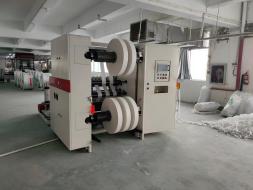
Slitter rewinder — shaftless unwind, razor slitting station and dual-shaft rewind
Two faults, and the setting that causes them
Fault seen on the roll | Root cause | Setting to check |
Telescoping — inner laps slide out | Wound too soft, or taper too aggressive at the core | Initial tension and taper curve |
Burrs or dust on the cut edge | Knife overlap wrong for the gauge | Blade overlap and side load |
Both models set tension from a continuously calculated roll diameter, not a fixed torque — which is what keeps a finished roll stable on the shelf.
CLFQ-W1100 Automatic High-Speed Rewinding and Slitting Machine
400 m/min mechanical speed, 1100 mm web, 30 mm minimum slit width — the model for film and foil work where narrow lanes and high output both matter.
Key advantages
l Narrow lanes at speed — slits down to 30 mm while running to 400 m/min, which is the combination that separates a production slitter from a finishing machine.
l Correction held to 0.30 mm — a U-shaped ultrasonic sensing system with a 30 mm guide rail underneath, so the lane position is corrected continuously rather than at start- up only.
l Tension calculated, not guessed — magnetic powder tension with the PLC computing roll diameter in real time, giving soft, precise control with no residual torque.
l Fast roll handling — shaftless hydraulic lifting rack with safety chuck locking and pneumatic loading and unloading, so a 1000 kg unwind roll is a one-person operation.
l Stable at any speed — an analogue-driven correction thruster removes the hunting that digital on-off thrusters produce.
Technical parameters
Maximum unwinding diameter | φ 1400 mm |
Maximum winding diameter | φ 1100 mm |
Unwinding width range | 100–1100 mm |
Slitting width | 30–1100 mm |
Core diameter (unwind / wind) | 3 ″ (ID φ76 mm, OD φ92 mm) |
Maximum mechanical speed | 400 m/min |
Maximum rewinding / cutting speed | 350 m/min |
Correction accuracy | ≤ 0.30 mm |
Tension setting range | 2–30 kg |
Unwind brake / winding motor | 200 N·m magnetic powder brake / 7.5 kW × 2 |
Total machine power | 23 kW |
Overall dimensions | 3500 × 3200 × 1900 mm |
Machine weight | 4000 kg |
Applicable materials | Kraft paper 30–300 g/m², white board, coated paper, aluminium foil, PVC, tin foil |
The two rewind shafts run alternately: one winds while the other is unloaded, so a roll change does not stop the line.
1300 Type Horizontal Slitting Machine
A 1300 mm horizontal slitter with fixed cut widths of45, 60, 65 and 90 cm — built for non- woven, aluminiumfoil, plastic film and rollpaper in packaging-converter duty.
Key advantages
l Built for heavy, wide rolls — a φ1500 mm unwind on a 3 ″ air-inflated shaft with a 200 N·m magnetic powder brake, so full mill rolls are handled without a shaft.
l Two independent tension zones — unwind and rewind each have their own magnetic powder clutch, so the rewind tension can be set for the lane while the unwind brake holds the parent roll.
l Photoelectric edge correction — 120 mm of correction travel at ±0.5 mm, which is ample for non-woven and foil where the parent roll edge is not straight.
l Automatic stop at length — the controller stops the machine when the set length is reached and adjusts speed to the line velocity, so a roll change is a controlled event.
l Ten circular knives — supplied as a set on a chain-driven, channel-steel frame, which keeps the machine stiff and the cut clean on heavy stock.
Technical parameters
Machine model | 1300 mm horizontal type |
Cutting materials | Non-woven fabric, aluminium foil, plastic film, roll paper |
Effective cutting widths | 45 / 60 / 65 / 90 cm |
Mechanical / cutting speed | 200 / 150 m/min |
Unwind diameter | φ 1500 mm on 3 ″ air-inflated shaft |
Rewind diameter | φ400 mm on 3 ″ air-inflated shaft |
Main motor | 5.5 kW |
Unwind brake / rewind clutch | 200 N·m magnetic powder brake / 200 N·m clutch |
Trimming / correction | 550 W fan; 120 mm travel, error ±0.5 mm |
Voltage / weight | 220 V, 50 Hz, three phase / 1200 kg |
Knives | Circular knife, 10 sets |
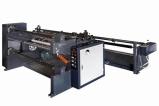
1300 Type horizontal slitter — 1500 mm unwind, circular knife bank and differential rewind
What the laminator and the slitter are judged on is the finished roll: bond strength, flatness,
print brightness after lamination, lane width, and whether the web runs cleanly on the bag maker afterwards. The samples below were produced on lines described in sections 04 and 05; they are customer work shown to illustrate achievable quality, not part of the supply scope.
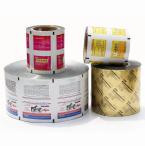
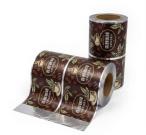
Pharmaceutical roll film —
multi-layer aluminium structure
Cofee packaging roll film — metallised, high-definition print
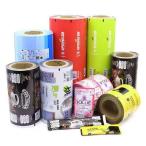
Multi-colour printed roll film — food and beverage

Finished roll and converted
packs — laminate to shelf-ready pack

Slit roll stock converted to
sachets, pouches and roll film
What is measured on these samples
Property | Method | Target |
Bond strength | Peel test on a 15 mm strip, 180° at 300 mm/min | Above the substrate yield, no clean peel |
Lane width | Measured at three points across the roll | ±0.3 mm on the ordered width |
Winding alignment | End-face inspection over the full roll | No telescoping; end faces flush within 1 mm |
How to read a sample
l Cut it open. A laminate is judged on the peel, not the surface — a clean interfacial peel means the adhesive weight is below specification.
Register, ink laydown and drying are judged on the printed roll, not on the press datasheet.
Both samples below were printed on the CI flexo platform described in section 02. What they demonstrate is the combination converters actually buy: dense solid coverage next to fine detail, and a repeat that holds across the full roll width for the whole run.

Printed web — continuous-tone imagery with
solid colour panels

Printed web —fine reverse type and multi-colour registration
What decides whether a printed roll is accepted
Criterion | What it means on press | Figure to hold |
Registration | Every colour lands inside the tolerance band across the full width, at running speed | ±0.08 mm to ±0.1 mm |
Dot gain | Halftone dots do not spread enough to close the shadow tones | Controlled by anilox and ink viscosity, not by pressure |
Ink laydown | Solid areas carry the same density at the centre and both edges | Measured across the web, not at one point |
Defects visible on a printed roll, and what causes them
l Fill-in in the shadow tones — anilox cell volume too high for the line count. Reduce volume before touching impression pressure.
l Register drift on one colour only — one servo axis or one encoder, not the press as a whole. Changing the whole register to chase it puts the other colours out.
Print designs shown are customer work produced on the equipment and are not part of the supply scope.
Every roll in the plant — parent, laminated, slit — needs a core cut to length. The requirement is simple; the tolerance is not: cores that vary by even a millimetre make the roll run off-centre on the unwinding shaft, which shows up as tension variation three processes upstream.
Q5-1200 Single-Knife Precision Paper Tube Re-Cutting Machine
One knife, servo-positioned, cutting tubes of 10–1200 mm length to a resolution of 0.01 mm —for high-volume production of short cores.
Key advantages
l Half a second per cut — a single-blade cycle time that makes high-volume short-tube production viable, with the timing adjusted for wall thickness.
l 0.01 mm cutting resolution — servo positioning on a precision ball screw rather than a mechanical stop, so length does not drift over a production run.
l Unattended between loads — automatic clamping, automatic stop and automatic unloading; one operator loads and the machine does the rest.
l Colour touchscreen on PLC control — tube length and cut count are set as parameters, so a changeover is a data entry rather than a mechanical adjustment.
Technical parameters
Tube length | 10–1200 mm |
Tube diameter | 50–200 mm |
Tube wall thickness | 1–20 mm |
Knife / cutting method | 1 blade; tube rotates, pneumatic knife feed |
Loading / unloading / operator | Manual load, automatic unload, 1 person |
Drive / main motor | Servo control, 1.5 kW |
Overall dimensions | 2300 × 750 × 1800 mm |
Total weight | 800 kg |
Cutting blades supplied | 2 pieces, plus 1 tool set |
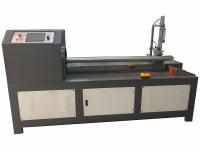
Q5-1200 — single-blade paper tube re-cutter with automatic tube pushing and PLC control
Equipment is only half of a packaging line; the other half is what runs through it, and a line configured for the wrong substrate never performs to specification. XIAOPAI therefore supplies the two consumables that decide output — resin for the extruder, finished laminate off the laminator.
Finished laminated film
Laminated roll film is supplied in the structures that dominate food-contact packaging: PET for print and heat resistance, PE for sealability, BOPP for stiffness and gloss, and PLA- based structures where a compostable pack is specified. They are combined to the barrier, seal and shelf-life requirement — two-layer PET/PE for a dry snack, metallised or foil- containing structures where oxygen and light matter, paper laminates for a natural finish.
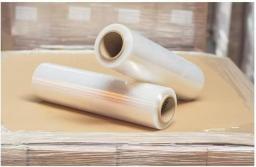
Laminated finished film supplied on roll, slit to the converter 's width
Blown-film grade resin
Extrusion-grade resin is supplied for the ABC-1800 line: LDPE for general-purpose film and seal layers, LLDPE and MLLDPE where puncture resistance and down-gauging matter, HDPE for stiffness and barrier in thin gauges — matched to the bag specification rather than the specification being written around what is on the floor.
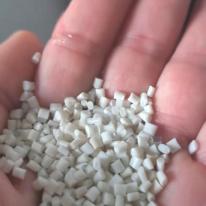
Blown-film grade resin pellets — LDPE/ LLDPE / MLLDPE/ HDPE
Film structures, thickness ranges and resin grades are quoted against your pack specification. Sample swatches and resin samples are available on request.
A packaging line is a long-term commitment on both sides. After the contract is signed, the buyer needs a specification that matches the machine, a schedule that holds, and an engineer who answers when a line stops at two in the morning.
What we commit to at each stage
Stage | What happens |
Line design | From your finished pack and output target we specify the machine, the utilities and the floor layout. |
Specification | The order confirmation states the configuration explicitly, including what the buyer prepares on site: power, air, foundation, plates, ink. |
Pre-shipment | The line is assembled and run before shipment; the test report goes to the buyer for approval. |
Installation | Engineers attend site for installation, commissioning and operator training, with a defined scope of days and responsibilities. |
After-sales | Spare and wearing parts kept available; remote diagnosis first, on-site attendance when needed. |
Warranty and service
Machines are supplied with a standard warranty from the date of acceptance. Wearing parts and damage from abnormal operation or unsuitable site conditions are outside warranty and quoted separately. Installation and training, where included, are scheduled against the buyer's site-readiness date.
Every machine leaves with a documentation set in English, a spare-parts list with lead times, and a named contact for technical questions after commissioning.
Contact
Company | Wenzhou Xiaopai Electric Power Technology Co., Ltd. |
Address | Room 601, Building 1, Tianrun Tower, 458 Shanghai Road, Louqiao Subdistrict, Ouhai District, Wenzhou City, Zhejiang Province, China |
Telephone / E-mail | +86 138 0653 6768 / kellen@cnxiaopai.com |
Website |
XIAOPAI · One-Stop Flexible Packaging Solutions


