


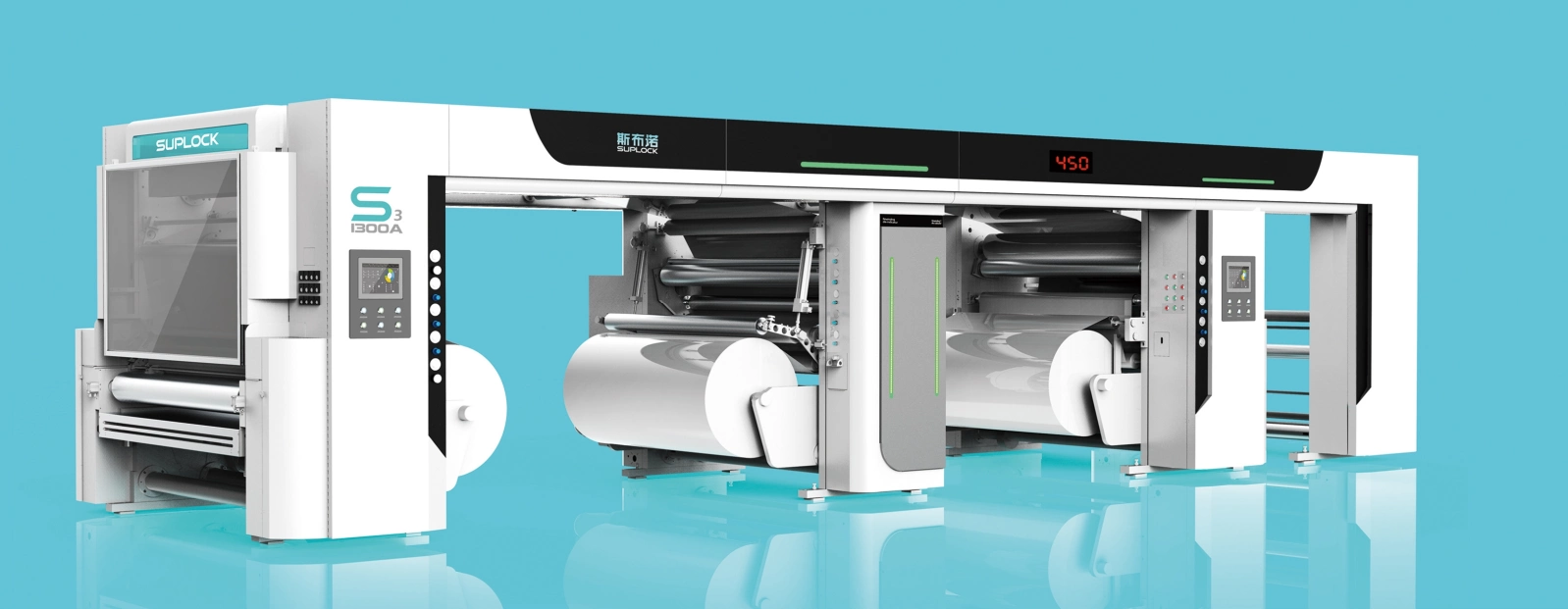
Buyers who search for a laminator machine automatic are usually trying to remove three manual steps from the line. They want the adhesive ratio set without a calculation, the limiting roller positioned without a feeler gauge, and tension corrected without an operator walking the web. The S3 triplex machine does all three on its own, and it does them while running three webs in a single pass at up to 450 m/min on webs 1,350 mm wide.
That last part is where the efficiency argument sits. Three layers in one pass changes the number of times a job goes through a machine, and the number of passes is easier to measure than any saving a supplier can quote.
ONE PASS OR TWO, THAT IS THE DECISION
A three-ply structure such as print film, adhesive and aluminum foil can be built on a two-ply machine. It takes two runs: the first laminate is made, left to cure, then fed back through the machine with the third web. Each run has its own start-up, its own splice, its own trim and its own climb to running speed.
The S3 removes the second run. Three unwinds feed the nip together, the adhesive is applied between the layers in one operation, and the finished laminate leaves on one rewind. For a converter weighing a triplex machine against a second two-ply unit, the comparison is not about floor space alone. It is about how many times the same metres travel through a machine before they become saleable.
The process side of that change is not trivial. That is why the technology gap in lamination keeps coming back to the same point: the fewer the passes, the fewer the chances to lose bond strength or trap air between layers.
WHAT THE SECOND PASS COSTS IN MACHINE HOURS
Take an order of 10,000 finished metres. On a two-ply machine that order consumes 20,000 metres of machine travel, because the web goes through twice. On the S3 it consumes 10,000 metres. At 450 m/min the difference is about 22 minutes of pure travel, before any ramp, splice or cure wait is counted.
| Per 10,000 m of finished laminate | Two-ply machine, two runs | S3 triplex, one run |
|---|---|---|
| Machine travel | 20,000 m | 10,000 m |
| Start-ups and ramps | 2 | 1 |
| Splices and trims | 2 | 1 |
| Intermediate cure wait | 1 | 0 |
| Handling cycles for the part-built laminate | 2 | 1 |
None of those rows is a claim about a specific plant. They are the structural difference between two passes and one, and every converter can put its own metres and its own order count against them.
The table assumes the same finished length on both routes. A plant that runs short orders feels the difference sooner, because every order carries the same start-up cost whether it is 2,000 m or 20,000 m.
THE OUTPUT FIGURE, AND WHY IT IS A CEILING
At the full 1,350 mm width and the top speed, the machine moves 607.5 square metres a minute, which is 36,450 square metres an hour. That number is arithmetic, and it is a ceiling rather than a schedule.
What a plant can book is that ceiling multiplied by the share of the shift the line actually runs. Ramps, splices, adhesive changes, roller cleaning and the thickness of the material all take a slice. A thin film structure runs nearer the top of the range, a heavy foil and paper structure runs well below it, and the machine does not apologise for either.
The honest way to use the figure is to compare it with the machine you run now, at the width you actually buy and the speed your material actually holds. A triplex machine that reaches a modest share of its ceiling can still beat a two-ply machine that reaches a high share of a lower one, because it only makes one pass.
WHERE THE WASTE ACTUALLY GOES
Waste on a laminating line comes from four places, and three of them scale with the number of passes. The first is the ramp, where the line runs below speed until tension and coating settle. The second is the splice. The third is the handling of a part-built roll between runs. The fourth is the reject that shows up later as a pinhole, a tunnel or a cloudy bond.
On 6 micron aluminum foil the last one matters most. The foil is fragile, it creases easily, and every extra unwind and rewind is another chance to damage it. The S3 loads foil from a low position on a short path, which the maker states is arranged so the adhesive does not strike back through the foil. Fewer handlings and no second pass remove two of the usual causes of pinholes before they start.
Coating weight is the other lever. The machine sets the adhesive ratio with one click and keeps four ratio protections in place, so a recipe that ran last month can run again without an operator recalculating it. The maker also stores up to 300 work orders, which turns a repeat job into a recall rather than a set-up. When something does drift, integrated inspection and a look at how coating defects start are worth more than a final visual check at the rewind.
THE MECHANICAL REASONS THE NUMBERS HOLD
Automation only helps if the mechanics underneath it are stable. Three details carry most of that load on this machine.
The first is the three-roller back pressure station. A longer nip contact area gives the adhesive more time under pressure, which is what keeps bond strength even across the width instead of strong at the centre and weak at the edges.
The second is the roller surface. The machine uses tungsten-carbide coated rollers, and the maker states five times the wear resistance of a standard roller. A hard surface matters on a machine that runs abrasive foil and filled film all day, because coating uniformity follows roller geometry, and roller geometry changes as a soft surface wears.
The third is tension. Five spindle servo motors work through a linkage, two motors with mechanical brakes handle high-viscosity adhesive, and the rewind uses adaptive taper tension rather than a fixed curve. That combination is what keeps a 1,350 mm web flat into the nip at 450 m/min, and in-line gauging is how a plant proves it stayed flat.
THE PAYBACK TEST FROM YOUR OWN RECORDS
Payback on a triplex machine is usually argued with a supplier's savings estimate. A plant can settle it with four numbers it already owns, and none of them needs anything from the sales side of the table.
The first is metres per shift at the width you actually run, not the maximum width. The second is metres scrapped per start-up, measured over ten starts rather than one. The third is the reject rate on structures that contain foil. The fourth is machine hours per order, including the intermediate cure wait that a two-pass route needs and a single pass does not.
With those four, the calculation is mechanical. If the third web removes one pass, you remove one ramp, one splice, one cure wait and one handling cycle per order, then multiply by the orders you run in a month. The result is machine hours and metres recovered, which is a production answer rather than a commercial one. The return on automation in most converting plants comes from exactly this kind of recovered time, not from a lower number on the order.
WHAT IT RUNS, AND WHO BUILDS IT
The S3 is built for multi-layer lamination of plastic film, metallized film, aluminum foil and paper. Unwind and rewind diameters are 800 mm at both ends. Cores are 3 inch and 6 inch, and loading is shaftless, so a full-width roll does not need a shaft handling step before it goes on.
The S3 is a laminator machine automatic in the sense that matters on a shift. The ratio, the roller position and the tension are set by the machine, and the operator supervises the run instead of adjusting it.
Typical work sits in food packaging, pharmaceutical packaging, personal care and industrial laminates, anywhere a three-ply structure with foil or metallized film has to hold a barrier and still convert cleanly. For two-ply work the same range includes the i9 two-layer machine, for general film work the Fi9 solventless laminator, and for thin or optical film the S1 digital machine.
SINSTAR builds the S3 under its SUPLOCK brand. Wenzhou Xiaopai Electric Power Technology Co., Ltd. supplies it as authorised distributor, with the documentation and the commissioning route attached.
The efficiency case does not rest on the top speed. It rests on the fact that a three-ply structure leaves the machine finished, and every metre that avoids a second pass is a metre that cannot be scrapped twice.


