XIAOPAI · Wenzhou Xiaopai Electric Power Technology Co., Ltd. · Zhejiang, China
A one-stop flexible packaging equipment solution provider in China is easy to describe and hard to prove. Five machines fit into five containers, and any trading company with a forwarder can arrange that. The difference appears later, on one sheet of paper that lists what will be measured, at which gauge, on which resin, and who signs when a number misses. Every flexible packaging line runs the same five stages: film blowing, printing, lamination, slitting, and cutting the paper cores the finished rolls wind on. The middle two swap order depending on the structure. Surface print goes down before lamination. Reverse print sits inside the laminate, protected by the sealant layer. That choice also decides whether slitting runs in line with the press or needs its own pass, which is a layout question disguised as a technical one.FIVE STAGES, ONE SIGNATURE
A line pieced together from five suppliers still produces film. It just fails in a way that eats weeks. When a laminated roll tears at the slitter, three parties can spend a week pointing at each other while the same fault keeps coming off the machine. Buying from one supplier removes the argument, not the physics. The stages still fight each other. Film blown at 120 m/min with a 1600 mm layflat has to reach the slitter flat enough to hold ±0.5 mm of guiding. It also has to be wound on a core round enough to spin at 200 m/min without bounce. Most of those interactions are settled during specification, long before a single drawing exists. They are rarely settled by the company that will ship it.THE FILM STAGE: 200 KG/H IS NOT A CEILING
On the ABC65/75/65-1800 line, take-up runs 100 to 120 m/min and the published output is 200 to 300 kg/h. Those two numbers describe different films. At 0.013 mm the line makes roughly 200 kg/h. Push the gauge toward 0.20 mm and the same take-up speed moves far more mass every hour. Thickness deviation is the number buyers should chase. The published figure is ≤±4%, and it arrives with a condition attached: LDPE, running 0.15 to 0.20 mm. A converter who will run 0.05 mm LLDPE cannot assume that tolerance transfers. The test has to be run at the gauge that will actually be sold, not at the one that flatters the machine. The ABC65/75/65-1800 three-layer line is specified for LDPE, LLDPE, MLLDPE and HDPE, with a 1600 mm layflat and a maximum winding diameter of Φ1000 mm. That last figure sets how heavy a roll one operator can move, which is a staffing question dressed as a machine spec. Roll bounce survives almost every other check and usually shows up in the first metres after a roll change, which is why the acceptance run should include two roll changes rather than none.LAMINATION: NO DRYER, NO PLACE TO HIDE
The WRJ Fi9 solventless laminating machine uses a five-roll coating system with closed-loop tension control and no drying tunnel. Removing the dryer removes the solvent, and that is the reason the machine goes into food, pharmaceutical and infant formula work where residual solvent is a compliance item rather than a preference. Solventless lamination moves the quality burden onto coat weight and nip. A two-component adhesive has to be mixed, applied evenly across the full web, and given time to build bond before anyone pulls a sample. The published substrate list covers BOPP, PET, PE, CPP, PA and aluminium foil, so the same machine has to behave across a wide spread of surface energies. The process variables that decide bond quality are well documented, and most of them are set before the first metre runs. Where a converter is still choosing between extrusion coating and adhesive lamination, the decision usually turns on structure and barrier rather than on line speed.
PRINT: 700 MM OF PRINTABLE WIDTH
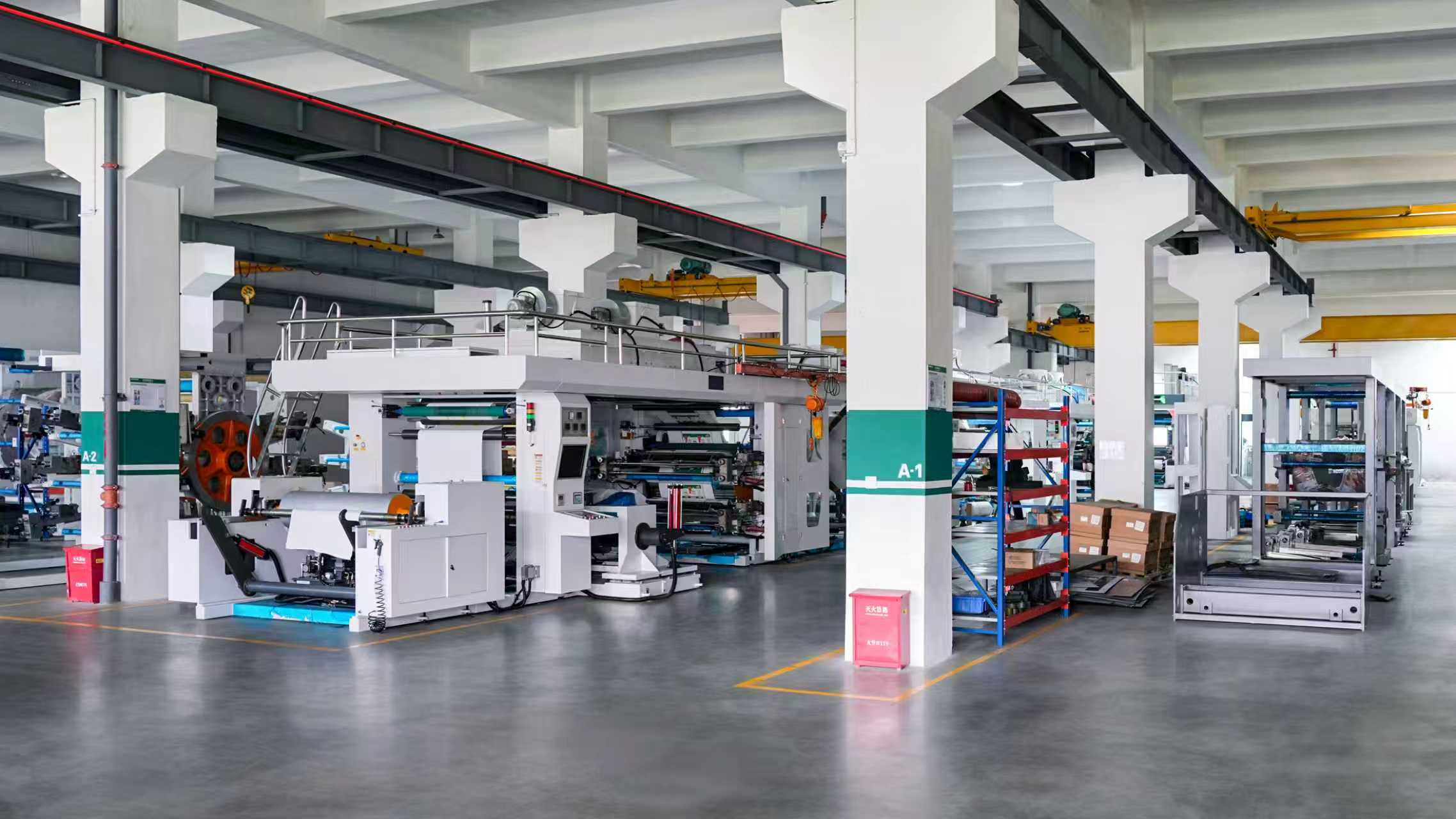
The Master Series CI flexo runs four colours from an 800 mm feed with a maximum print width of 700 mm. Repeat length spans 360 to 900 mm, and top speed is 150 m/min. Plate thickness comes in 1.7, 2.28 and 2.84 mm, with 0.2 to 0.5 mm embossing depth and a 0 to 45 degree shift angle. Register is the acceptance item. Measure it at top speed, not at a comfortable 80 m/min, and measure it on a short repeat. A 360 mm repeat leaves less room for error than a 900 mm one, so a press that holds register on the long job can still fail the short one. Roll handling ties the press back to the rest of the line. Maximum roll diameter is Φ1500 mm on a 6 inch air shaft. That 6 inch figure is a core requirement wearing a press badge.SLITTING: ±0.5 MM AT 200 M/MIN
The Type 1300 slitter carries a 1300 mm slitting width, 200 m/min mechanical speed, a 5.5 kW main motor and ±0.5 mm guiding accuracy. It handles fixed-width slitting, edge trimming and rewinding on plastic film, foil, non-woven and roll paper. Guiding accuracy is a machine number. Finished roll quality is a line number. A slitter that holds ±0.5 mm on a good master roll still delivers stepped edges when the incoming roll has hard and soft bands, and those bands were made one stage upstream at the winder. The Type 1300 slitting machine is where every earlier error becomes visible and countable. Ten defects that trace back to this stage make a useful checklist for the acceptance run, and most throughput gains come from setup and handling rather than from a higher speed on the plate.THE CORE STAGE NOBODY PUTS ON THE SHEET
Paper cores sit outside most equipment lists. They are bought by the kilometre, cut to length, and treated as consumables. They are also the interface between a finished roll and every shaft in the plant. The Q5-1200 re-cutting machine covers tube lengths of 10 to 1500 mm, diameters of 50 to 200 mm and wall thickness of 1 to 20 mm. Each cut takes 0.5 s and the cutting resolution is 0.01 mm. It runs on a servo and ball screw, needs one operator, and takes up 2300 x 750 x 1800 mm at 800 kg. A 50 to 200 mm diameter range covers the 76.2 mm and 152.4 mm cores that most flexible packaging shafts accept. If a provider can cut to 0.01 mm and still cannot say which core diameter the 6 inch air shaft needs, the one-stop claim is a catalogue, not a capability. The Q5-1200 paper tube re-cutting machine is the smallest item on a five-stage line and the fastest way to find out whether the line was planned as a system. Differential shafts grip the core, so core tolerance and shaft choice cannot be specified apart. Crushed cores are common enough that a repair tool exists for them, and core makers publish their own tolerances, which belong in the acceptance sheet next to the machine numbers.WHAT THE PAPERWORK HAS TO SHOW
An acceptance sheet with five rows is enough. Gauge and thickness deviation at the sold gauge. Coat weight and bond strength for the laminated structure. Register at top speed on the shortest repeat. Edge straightness and roll hardness after slitting. Core length, diameter and wall thickness against the drawing. Each row needs a material, a speed and a sample size. A thickness check on three metres of film proves nothing. A 30 minute run sampled at five points across the layflat produces a number a buyer can hold a supplier to. The sheet also has to say what happens on a miss. Rework, re-test, or hold the shipment. A provider who will not write that sentence has not accepted the test, only the order.WHAT A TRADER CANNOT PASS
Three questions separate a solution provider from a reseller, and none of them can be answered from a catalogue. Which stage limits output at my gauge, and by how much? What happens to the core diameter when the plant moves from a 3 inch to a 6 inch shaft? Who owns the fault when a laminated roll fails at the slitter? The second question is the sharp one. It forces a supplier to connect a press, a slitter and a core cutter in a single answer, and it exposes whether those three machines were ever specified together. Core selection by end use is a subject of its own, and a line that ignores it will lose yield in the last two metres of every roll. A trader answers the first question with a speed number and the third with a promise. A provider answers with a drawing.WHAT XIAOPAI SUPPLIES
XIAOPAI works with manufacturers in flexible packaging, and XIAOPAI supplies the five stages as one scope: film blowing, solventless lamination, printing, slitting and core cutting. The WRJ solventless range is manufactured by SINSTAR in Chongqing, and XIAOPAI acts as authorized distributor for the range worldwide. Integration, documentation and technical service are handled from Wenzhou by Wenzhou Xiaopai Electric Power Technology Co., Ltd. The five machine models sit on the XIAOPAI product pages, so every number in this article can be checked before a call. The published scope covers snack and food film, frozen and cold chain structures, pharmaceutical aluminium-plastic laminates, infant formula packaging and personal care. Those five applications do not need five suppliers. They need one party who will write down which gauge, which structure and which core each one uses. That is the whole test. Ask for the acceptance sheet before the order, and read the core row first.ONE LINE FOR THE RECORD
A one-stop line is not five machines from one invoice. It is five stages measured on one sheet, with a core diameter that matches the shaft at the end of it.


